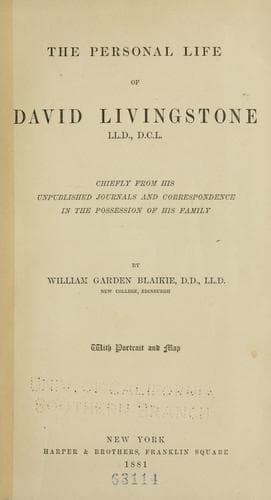
The Personal Life of David Livingstone: Chiefly from his Unpublished Journals and Correspondence in the Possession of His FamilyBlaikie, William Garden
Religion
The Personal Life of David Livingstone: Chiefly from his Unpublished Journals and Correspondence in the Possession of His Family
Blaikie, William Garden
Livingstone, David, 1813-1873
When Livingstone arrived at the Cape, he found the authorities in a
state of excitement over the Caffre War, and very far from friendly
toward the London Missionary Society, some of whose
missionaries--himself among the number--were regarded as "unpatriotic."
He had a very poor opinion of the officials, and their treatment of the
natives scandalized him. He describes the trial of an old soldier,
Botha, as "the most horrid exhibition I ever witnessed." The noble
conduct of Botha in prison was a beautiful contrast to the scene in
court. This whole Caffre War had exemplified the blundering of the
British authorities, and was teaching the natives developments, the
issue of which could not be foreseen. As for himself, he writes to Mr.
Moffat, that he was cordially hated, and perhaps he might be pulled up;
but he knew that some of his letters had been read by the Duke of
Wellington and Lord Brougham with pleasure, and, possibly, he might get
justice. He bids his father-in-law not to be surprised if he saw him
abused in the newspapers.
On the 23d April, 1852, Mrs. Livingstone and the four children sailed
from Cape Town for England. The sending of his children to be brought up
by others was a very great trial, and Dr. Livingstone seized the
opportunity to impress on the Directors that those by whom missionaries
were sent out had a great duty to the children whom their parents were
compelled to send away. Referring to the filthy conversation and ways of
the heathen, he says:
"Missionaries expose their children to a contamination which
they have had no hand in producing. We expose them and
ourselves for a time in order to elevate those sad captives
of sin and Satan, who are the victims of the degradation of
ages. None of those who complain about missionaries sending
their children home ever descend to this. And again, as Mr.
James in his _Young Man from Home_ forcibly shows, a greater
misfortune cannot befall a youth than to be cast into the
world without a home. In regard to even the vestige of a
home, my children are absolutely vagabonds. When shall we
return to Kolobeng? When to Kuruman? _Never_. The mark of
Cain is on your foreheads, your father is a missionary. Our
children ought to have both the sympathies and prayers of
those at whose bidding we become strangers for life."
Public-domain text, read in full here on John Shaqi.
Reviews
Reviews
No reviews yet
Be the first to share your thoughts on this work.
Elsewhere in the archive
Join the Discussion
Join the discussion
Sign in to leave a comment or review.
Sign InorCreate an account