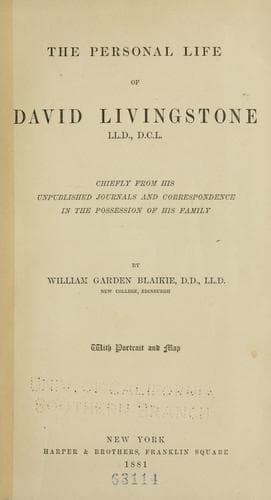
The Personal Life of David Livingstone: Chiefly from his Unpublished Journals and Correspondence in the Possession of His FamilyBlaikie, William Garden
Religion
The Personal Life of David Livingstone: Chiefly from his Unpublished Journals and Correspondence in the Possession of His Family
Blaikie, William Garden
Livingstone, David, 1813-1873
"_Kuruman, 20th September_, 1852.--Along with this I send you
a long letter; this I write in order to give you the latest
news. The Boers gutted our house at Kolobeng; they brought
four wagons down and took away sofa, table, bed, all the
crockery, your desk (I hope it had nothing in it--Have you
the letters?), smashed the wooden chairs, took away the iron
ones, tore out the leaves of all the books, and scattered
them in front of the house, smashed the bottles containing
medicines, windows, oven-door, took away the smith-bellows,
anvil, all the tools,--in fact everything worth taking; three
corn-mills, a bag of coffee, for which I paid six pounds, and
lots of coffee, tea, and sugar, which the gentlemen who went
to the north left; took all our cattle and Paul's and
Mebalwe's. They then went up to Limaüe, went to church
morning and afternoon, and heard Mebalwe preach! After the
second service they told Sechéle that they had come to fight,
because he allowed Englishmen to proceed to the North, though
they had repeatedly ordered him not to do so. He replied that
he was a man of peace, that he could not molest Englishmen,
because they had never done him any harm, and always treated
him well. In the morning they commenced firing on the town
with swivels, and set fire to it. The heat forced some of the
women to flee, the men to huddle together on the small hill
in the middle of the town; the smoke prevented them seeing
the Boers, and the cannon killed many, sixty (60) Bakwains.
The Boers then came near to kill and destroy them all, but
the Bakwains killed thirty-five (35), and many horses. They
fought the whole day, but the Boers could not dislodge them.
They stopped firing in the evening, and then the Bakwains
retired on account of having no water. The above sixty are
not all men; women and children are among the slain. The
Boers were 600, and they had 700 natives with them. All the
corn is burned. Parties went out and burned Bangwaketse town,
and swept off all the cattle. Sebubi's cattle are all gone.
All the Bakhatla cattle gone. Neither Bangwaketse nor
Bakhatla fired a shot. All the corn burned of the whole three
tribes. Everything edible is taken from them. How will they
live! They told Sechéle that the Queen had given off the land
to them, and henceforth they were the masters,--had abolished
chieftainship. Sir Harry Smith tried the same, and England
has paid two millions of money to catch one chief, and he is
still as free as the winds of heaven. How will it end? I
don't know, but I will tell you the beginning. There are two
parties of Boers gone to the Lake. These will to a dead
certainty be cut off. They amount to thirty-six men. Parties
are sent now in pursuit of them. The Bakwains will plunder
Public-domain text, read in full here on John Shaqi.
Reviews
Reviews
No reviews yet
Be the first to share your thoughts on this work.
Elsewhere in the archive
Join the Discussion
Join the discussion
Sign in to leave a comment or review.
Sign InorCreate an account