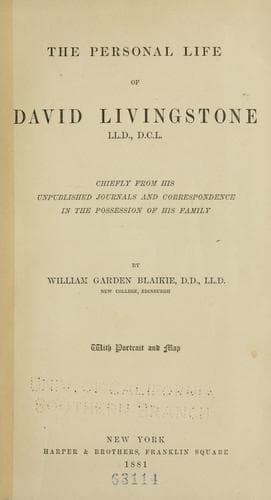
The Personal Life of David Livingstone: Chiefly from his Unpublished Journals and Correspondence in the Possession of His FamilyBlaikie, William Garden
Religion
The Personal Life of David Livingstone: Chiefly from his Unpublished Journals and Correspondence in the Possession of His Family
Blaikie, William Garden
Livingstone, David, 1813-1873
The country was so unsettled that for a long time Dr. Livingstone could
not get guides at Kuruman to go with him to Sebituane's. At length,
however, he succeeded, and leaving Kuruman finally about the end of
December, 1852, in company with George Fleming, Mr. Rutherfoord's
trader, he set out in a new direction, to the west of the old, in order
to give a wide berth to the Boers. Traveling rapidly he passed through
Sebituane's country, and in June, 1858, arrived at Linyanti, the capital
of the Makololo. He wrote to his wife that he had been very anxious to
go to Kolobeng and see with his own eyes the destruction wrought by the
savages. He had a great longing, too, to visit once more the grave of
Elizabeth, their infant daughter, but he heard that the Boers were in
the neighborhood, and were anxious to catch him, and he thought it best
not to go. Two years before, he had been at Linyanti with Mr. Oswell.
Many details of the new journey are given in the _Missionary Travels_,
which it is unnecessary to repeat, It may be enough to state that he
found the country flooded, and that on the way it was no unusual thing
for him to be wet all day, and to walk through swamps, and water three
or four feet deep. Trees, thorns, and reeds offered tremendous
resistance, and he and his people must have presented a pitiable sight
when forcing their way through reeds with cutting edges. "With our own
hands all raw and bloody, and knees through our trousers, we at length
emerged." It was a happy thought to tear his pocket-handkerchief into
two parts and tie them over his knees. "I remember," he says in his
Journal, referring to last year's journey, "the toil which our friend
Oswell endured on our account. He never spared himself." It is not to be
supposed that his guides were happy in such a march; it required his
tact stretched to its very utmost to prevent them from turning back. "At
the Malopo," he writes to his wife, "there were other dangers besides.
When walking before the wagon in the morning twilight, I observed a
lioness about fifty yards from me, in the squatting way they walk when
going to spring. She was followed by a very large lion, but seeing the
wagon, she turned back." Though he escaped fever at first, he had
repeated attacks afterward, and had to be constantly using remedies
against it. The unhealthiness of the region to Europeans forced itself
painfully on his attention, and made him wonder in what way God would
bring the light of the gospel to the poor inhabitants. As a physician
his mind was much occupied with the nature of the disease, and the way
to cure it. If only he could discover a remedy for that scourge of
Africa, what an invaluable boon would he confer on its
much-afflicted people!
Public-domain text, read in full here on John Shaqi.
Reviews
Reviews
No reviews yet
Be the first to share your thoughts on this work.
Elsewhere in the archive
Join the Discussion
Join the discussion
Sign in to leave a comment or review.
Sign InorCreate an account