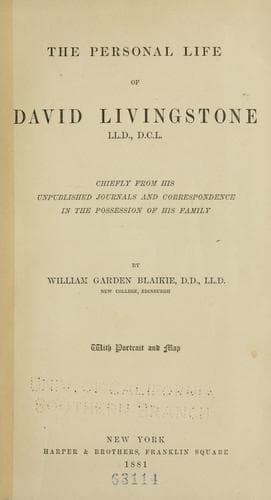
The Personal Life of David Livingstone: Chiefly from his Unpublished Journals and Correspondence in the Possession of His FamilyBlaikie, William Garden
Religion
The Personal Life of David Livingstone: Chiefly from his Unpublished Journals and Correspondence in the Possession of His Family
Blaikie, William Garden
Livingstone, David, 1813-1873
"_1st June_.--The chief presented eight large and three small
tusks this morning. I told him and his people I would rather
see them trading than giving them to me. They replied that
they would get trade with George Fleming, and that, too, as
soon as he was well; but these they gave to their father, and
they were just as any other present. They asked after the
gun-medicine, believing that now my heart would be warm
enough to tell them anything, but I could not tell them a
lie. I offered to show Sekelétu how to shoot, and that was
all the medicine I knew. I felt as if I should have been more
pleased had George been amassing ivory than I. Yet this may
be an indispensable step in the progress toward opening the
west. I must have funds; and here they come pouring in. It
would be impossible to overlook his providence who has
touched their hearts. I have used no undue influence. Indeed
I have used none directly for the purpose Kindness shown has
been appreciated here, while much greater kindness shown to
tribes in the south has resulted in a belief we missionaries
must be fools. I do thank my God sincerely for his favor, and
my hearty prayer is that He may continue it, and make
whatever use He pleases of me, and may He have mercy on this
people!"
Dr. Livingstone was careful to guard against the supposition that he
allowed Sekelétu to enrich him without recompense, and in his Journal he
sets down a list of the various articles presented by himself to the
chief, including three goats, some fowls, powder, wire, flints,
percussion-caps, an umbrella and a hat, the value of the whole being
£31, 16s. When Sekelétu knew Dr. Livingstone's plans, he undertook that
he should be provided with all requisites for his journey. But he was
most anxious to retain him, and for some time would not let him go.
Livingstone had fascinated him. Sekelétu said that he had found a new
father. And Livingstone pondered the possibility of establishing a
station here. But the fever, the fever! could he bring his family? He
must pass on and look for a healthier spot. His desire was to proceed to
the country of the Barotse. At length, on the 16th June, Sekelétu gives
his answer:
"The chief has acceded to my request to proceed to Barotse
and see the country. I told him my heart was sore, because
having left my family to explore his land, and, if possible,
find a suitable location for a mission, I could not succeed,
because detained by him here. He says he will take me with
him. He does not like to part with me at all. He is obliged
to consult with those who gave their opinion against my
leaving. But it is certain I am permitted to go. Thanks be to
God for influencing their hearts!"
Public-domain text, read in full here on John Shaqi.
Reviews
Reviews
No reviews yet
Be the first to share your thoughts on this work.
Elsewhere in the archive
Join the Discussion
Join the discussion
Sign in to leave a comment or review.
Sign InorCreate an account