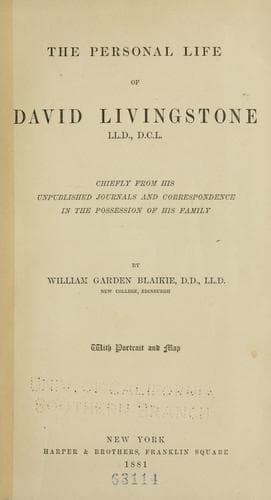
The Personal Life of David Livingstone: Chiefly from his Unpublished Journals and Correspondence in the Possession of His FamilyBlaikie, William Garden
Religion
The Personal Life of David Livingstone: Chiefly from his Unpublished Journals and Correspondence in the Possession of His Family
Blaikie, William Garden
Livingstone, David, 1813-1873
The friendship of Mr. Gabriel was honorable both to himself and to Dr.
Livingstone. At a very early period he learned to appreciate Livingstone
thoroughly, he saw how great as well as how good a man he was, and felt
that to be the friend of such a man was one of the highest distinctions
he could have. After Livingstone left Loanda, and while he was detained
within reach of letters, a brisk correspondence passed between them; Mr.
Gabriel tells him about birds, helps him in his schemes for promoting
lawful commerce, goes into ecstasies over a watch-chain which he had got
from him, tells him the news of the battle of the Alma in the Crimea, in
which his friend, Colonel Steele, had distinguished himself, and of the
success of the Rae Expedition in finding the remains of the party under
Sir John Franklin. In an official communication to Lord Clarendon, after
Livingstone had left, Mr. Gabriel says, 5th August, 1855: "I am grieved
to say that this excellent man's health has suffered a good deal [on the
return journey]. He nevertheless wrote in cheerful spirits, sanguine of
success in doing his duty under the guidance and protection of that kind
Providence who had always carried him through so many perils and
hardships. He assures me that since he knew the value of Christianity,
he has ever wished to spend his life in propagating its blessings among
men, and adds that the same desire remains still as strong as ever."
While Livingstone was at Loanda, he made several acquaintances among the
officers of Her Majesty's navy, engaged in the suppression of the
slave-trade. For many of these gentlemen he was led to entertain a high
regard. Their humanity charmed him, and so did their attention to their
duties. In his early days, sharing the feeling then so prevalent in his
class, he had been used to think of epauleted gentlemen as idlers, or
worse--"_fruges consumere nati_" Personal acquaintance, as in so many
other cases, rubbed off the prejudice. In many ways Livingstone's mind
was broadening. His intensely sympathetic nature drew powerfully to all
who were interested in what was rapidly becoming his own
master-idea--the suppression of the slave-trade. We shall see proofs not
a few, how this sympathetic affection modified some of his early
opinions, and greatly widened the sphere of his charity.
Public-domain text, read in full here on John Shaqi.
Reviews
Reviews
No reviews yet
Be the first to share your thoughts on this work.
Elsewhere in the archive
Join the Discussion
Join the discussion
Sign in to leave a comment or review.
Sign InorCreate an account