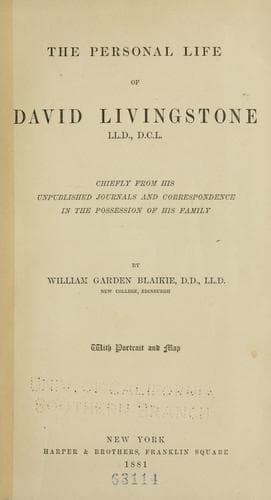
The Personal Life of David Livingstone: Chiefly from his Unpublished Journals and Correspondence in the Possession of His FamilyBlaikie, William Garden
Religion
The Personal Life of David Livingstone: Chiefly from his Unpublished Journals and Correspondence in the Possession of His Family
Blaikie, William Garden
Livingstone, David, 1813-1873
In traversing the road backward along which he had already come, not
many things happened that demand special notice in this brief sketch. We
find him both in his published book and still more in his private
Journal repeating his admiration of the country and its glorious
scenery. This revelation of the marvelous beauty of a country hitherto
deemed a sandy desert was one of the most astounding effects of
Livingstone's travels on the public mind. But the more he sees of the
people the more profound does their degradation appear, although the
many instances of remarkable kindness to himself, and occasional cases
of genuine feeling one toward another, convinced him that there was a
something in them not quite barbarised. On one point he was very
clear--the Portuguese settlements among them had not improved them. Not
that he undervalued the influences which the Portuguese had brought to
bear on them; he had a much more favorable opinion of the Jesuit
missions than Protestants have usually allowed themselves to entertain,
and felt both kindly and respectfully toward the padres, who in the
earlier days of these settlements had done, he believed, a useful work.
But the great bane of the Portuguese settlements was slavery. Slavery
prevented a good example, it hindered justice, it kept down improvement.
If a settler took a fancy to a good-looking girl, he had only to buy
her, and make her his concubine. Instead of correcting the polygamous
habits of the chiefs and others, the Portuguese adopted like habits
themselves. In one thing indeed they were far superior to the Boers--in
their treatment of the children born to them by native mothers. But the
whole system of slavery gendered a blight which nothing could
counteract; to make Africa a prosperous land, liberty must be proclaimed
to the captive, and the slave system, with all its accursed
surroundings, brought conclusively to an end. Writing to Mrs.
Livingstone from Bashinge, 20th March, 1855, he gives, some painful
particulars of the slave-trade. Referring to a slave-agent with whom he
had been, he says:
Public-domain text, read in full here on John Shaqi.
Reviews
Reviews
No reviews yet
Be the first to share your thoughts on this work.
Elsewhere in the archive
Join the Discussion
Join the discussion
Sign in to leave a comment or review.
Sign InorCreate an account