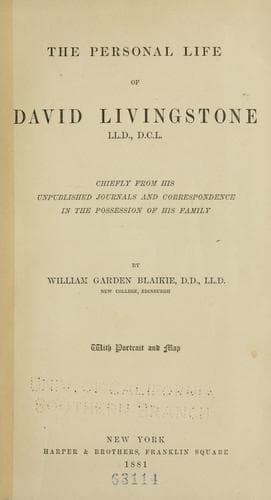
The Personal Life of David Livingstone: Chiefly from his Unpublished Journals and Correspondence in the Possession of His FamilyBlaikie, William Garden
Religion
The Personal Life of David Livingstone: Chiefly from his Unpublished Journals and Correspondence in the Possession of His Family
Blaikie, William Garden
Livingstone, David, 1813-1873
On reaching the country of the Barotse, the home of most of them, a day
of thanksgiving was observed (23d July, 1855). The men had made little
fortunes in Loanda, earning sixpence a day for weeks together by helping
to discharge a cargo of coals or, as they called them, "stones that
burned." But, like Livingstone, they had to part with everything on the
way home, and now they were in rags; yet they were quite as cheerful and
as fond of their leader as ever, and felt that they had not traveled in
vain. They quite understood the benefit the new route would bring in the
shape of higher prices for tusks and the other merchandise of home. On
the thanksgiving day--
"The men decked themselves out in their best, for all had
managed to preserve their suits of European clothing, which,
with their white and red caps, gave them a rather dashing
appearance. They tried to walk like soldiers, and called
themselves 'my braves.' Having been again saluted with salvos
from the women, we met the whole population, and having given
an address on divine things, I told them we had come that day
to thank God before them all for his mercy in preserving us
from dangers, from strange tribes and sicknesses. We had
another service in the afternoon. They gave us two fine oxen
to slaughter, and the women have supplied us abundantly with
milk and meal. This is all gratuitous, and I feel ashamed
that I can make no return. My men explain the whole
expenditure on the way hither, and they remark gratefully:
'It does not matter, you have opened a path for us, and we
shall have sleep.' Strangers from a distance come flocking to
see me, and seldom come empty-handed. I distribute all
presents among my men."
Several of the poor fellows on reaching home found domestic trouble--a
wife had proved inconstant and married another man. As the men had
generally more wives than one, Livingstone comforted them by saying that
they still had as many as he.
Amid the anxieties and sicknesses of the journey, and multiplied
subjects of thought and inquiry, Livingstone was as earnest as ever for
the spiritual benefit of the people. Some extracts from his Journal will
illustrate his efforts in this cause, and the flickerings of hope that
would spring out of them, dimmed, however, by many fears:
_August 5, 1855_.--A large audience listened attentively to
my address this morning, but it is impossible to indulge any
hopes of such feeble efforts. God is merciful, and will deal
with them in justice and kindness. This constitutes a ground
of hope. Poor degraded Africa! A permanent station among them
might effect something in time, but a Considerable time is
necessary. Surely some will pray to their merciful Father in
their extremity, who never would have thought of Him but for
our visit."
Public-domain text, read in full here on John Shaqi.
Reviews
Reviews
No reviews yet
Be the first to share your thoughts on this work.
Elsewhere in the archive
Join the Discussion
Join the discussion
Sign in to leave a comment or review.
Sign InorCreate an account