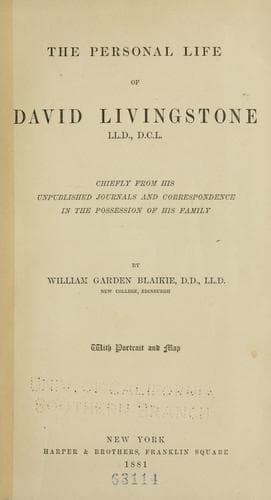
The Personal Life of David Livingstone: Chiefly from his Unpublished Journals and Correspondence in the Possession of His FamilyBlaikie, William Garden
Religion
The Personal Life of David Livingstone: Chiefly from his Unpublished Journals and Correspondence in the Possession of His Family
Blaikie, William Garden
Livingstone, David, 1813-1873
With regard to that part of Africa which he had been exploring, he gives
his views at great length in a letter to the Directors, dated Linyanti,
12th October, 1855. After fully describing the physical features of the
country, he fastens on the one element which, more than any other, was
likely to hinder missions--fever. He does not deny that it is a serious
obstacle. But he argues at great length that it is not insurmountable.
Fever yields to proper treatment. His own experience was no rule to
indicate what might be reckoned on by others. His journeys had been made
under the worst possible conditions. Bad food, poor nursing,
insufficient medicines, continual drenchings, exhausting heat and toil,
and wearing anxiety had caused much of his illness. He gives a touching
detail of the hardships incident to his peculiar case, from which other
missionaries would be exempted, but with characteristic manliness he
charges the Directors not to publish that part of his letter, lest he
should appear to be making too much of his trials. "Sacrifices" he could
never call them, because nothing could be worthy of that name in the
service of Him who, though he was rich, for our sakes became poor. Two
or three times every day he had been wet up to the waist in crossing
streams and marshy ground. The rain was so drenching that he had often
to put his watch under his arm-pit to keep it dry. His good ox Sindbad
would never let him hold an umbrella. His bed was on grass, with only a
horse-cloth between. His food often consisted of bird-seed,
manioc-roots, and meal. No wonder if he suffered much. Others would not
have all that to bear. Moreover, if the fever of the district was
severe, it was almost the only disease. Consumption, scrofula, madness,
cholera, cancer, delirium tremens, and certain contagious diseases of
which much was heard in civilized countries, were hardly known. The
beauty of some parts of the country could not be surpassed. Much of it
was densely peopled, but in other parts the population was scattered.
Many of the tribes were friendly, and, for reasons of their own, would
welcome missionaries. The Makololo, for example, furnished an inviting
field. The dangers he had encountered arose from the irritating
treatment the tribes had received from half-cast traders and
slave-dealers, in consequence of which they had imposed certain taxes on
travelers, which, sometimes, he and his brother-chartists had refused to
pay. They were mistaken for slave-dealers. But character was a powerful
educator. A body of missionaries, maintaining everywhere the character
of honest, truthful, kind-hearted Christian gentlemen, would scatter
such prejudices to the winds.
Public-domain text, read in full here on John Shaqi.
Reviews
Reviews
No reviews yet
Be the first to share your thoughts on this work.
Elsewhere in the archive
Join the Discussion
Join the discussion
Sign in to leave a comment or review.
Sign InorCreate an account