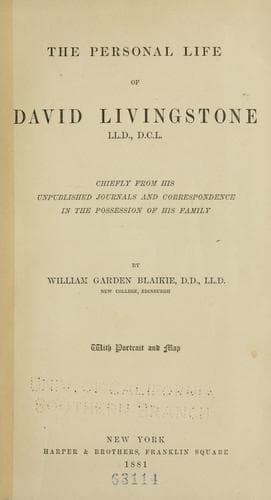
The Personal Life of David Livingstone: Chiefly from his Unpublished Journals and Correspondence in the Possession of His FamilyBlaikie, William Garden
Religion
The Personal Life of David Livingstone: Chiefly from his Unpublished Journals and Correspondence in the Possession of His Family
Blaikie, William Garden
Livingstone, David, 1813-1873
In reply, Livingstone acknowledged the kindness of the Directors, with
whom, for sixteen years, he had never had a word of difference. He
referred to the slowness of the African tribes, in explanation of the
comparatively small progress of the gospel among them. He cordially
acknowledged the great services of the British squadron on the West
Coast in the repressing of the slave-trade. He had been told that to
make such explorations as he was engaged in was only a tempting of
Providence, but such ridiculous assertions were only the utterances of
the weaker brethren.
Lord Shaftesbury's words at the close of this meeting, in honor of Mrs.
Livingstone, deserve to be perpetuated:
"That lady," he said, "was born with one distinguished name,
which she had changed for another. She was born a Moffat, and
she became a Livingstone. She cheered the early part of our
friend's earner by her spirit, her counsel, and her society.
Afterward, when she reached this country, she passed many
years with her children in solitude and anxiety, suffering
the greatest fears for the welfare of her husband, and yet
enduring all with patience and resignation, and even joy,
because she had surrendered her best feelings, and sacrificed
her own private interests, to the advancement of civilization
and the great interests of Christianity."
A more general meeting was held in the Mansion House on the 5th of
January, to consider the propriety of presenting a testimonial to Dr.
Livingstone. It was addressed by the Bishop of London, Mr. Raikes
Currie, and others.
Meanwhile, a sensible impulse was given to the _scientific_ enthusiasm
for Livingstone by the arrival of the report of a great meeting held in
Africa itself in honor of the missionary explorer. At Cape Town, on 12th
November, 1856, His Excellency the Governor, Sir George Grey, the
Colonial Secretary, the Astronomer-Royal, the Attorney-General, Mr.
Rutherfoord, the Bishop, the Rev. Mr. Thompson, and others, vied with
each other in expressing their sense of Livingstone's character and
work. The testimony of the Astronomer-Royal to Livingstone's eminence as
an astronomical observer was even more emphatic than Murchison's and
Owen's to his attainments in geography and natural history. Going over
his whole career, Mr. Maclear showed his unexampled achievements in
accurate lunar observation. "I never knew a man," he said, "who, knowing
scarcely anything of the method of making geographical observations, or
laying down positions, became so soon an adept, that he could take the
complete lunar observation, and altitudes for time, within fifteen
minutes." His observations of the course of the Zambesi, from Seshéke to
its confluence with the Lonta, were considered by the Astronomer-Royal
to be "the finest specimens of sound geographical observation he ever
met with."
Public-domain text, read in full here on John Shaqi.
Reviews
Reviews
No reviews yet
Be the first to share your thoughts on this work.
Elsewhere in the archive
Join the Discussion
Join the discussion
Sign in to leave a comment or review.
Sign InorCreate an account