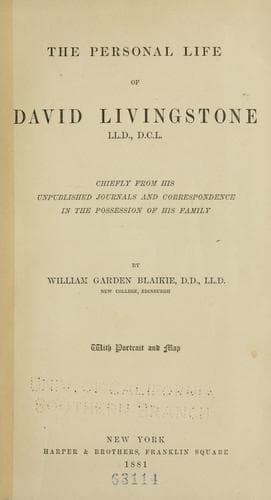
The Personal Life of David Livingstone: Chiefly from his Unpublished Journals and Correspondence in the Possession of His FamilyBlaikie, William Garden
Religion
The Personal Life of David Livingstone: Chiefly from his Unpublished Journals and Correspondence in the Possession of His Family
Blaikie, William Garden
Livingstone, David, 1813-1873
'I am in a position to express my earnest conviction, formed
in long, intimate, unreserved communications with him,
personally and by letter, that in the privations, sufferings,
and dangers he has passed through, during the last eight
years, he has not been actuated by mere curiosity; or the
love of adventure, or the thirst for applause, or by any
other object, however laudable in itself, less than his
avowed one as a messenger of Christian love from the
Churches. If ever there was a man who, by realizing the
obligations of his sacred calling as a Christian missionary,
and intelligently comprehending its object, sought to pursue
it to a successful issue, such a man is Dr. Livingstone. The
spirit in which he engages in his work may be seen in the
following extract from one of his letters: 'You kindly say
you fear for the result of my going in alone. I hope I am in
the way of duty; my own conviction that such is the case has
never wavered. I am doing something for God. I have preached
the gospel in many a spot where the name of Christ has never
been heard, and I would wish to do still more in the way of
reducing the Barotse language, if I had not suffered so
severely from fever. Exhaustion produced vertigo, causing
me, if I looked suddenly up, almost to lose consciousness;
this made me give up sedentary work; but I hope God will
accept of what I can do.'
A third gentleman at this meeting, Mr. Rutherfoord, who had known
Livingstone for many years, besides describing him as "one of the most
honorable, benevolent, conscientious men I ever met with," bore
testimony to his capacity in mercantile affairs; not exercised in his
own interest, but in that of others. It was Mr. Rutherfoord who, when
Livingstone was at the Cape in 1852, entered into his plans for
supplanting the slave-trade by lawful traffic, and at his suggestion
engaged George Fleming to go north with him as a trader, and try the
experiment. The project was not very successful, owing to innumerable
unforeseen worries, and especially the rascality of Fleming's men.
Livingstone found it impossible to take Fleming to the coast, and had
therefore to send him back, but he did his utmost to prevent loss to his
friend; and thus, as Mr. Rutherfoord said, "at the very time that he was
engaged in such important duties, and exposed to such difficulties, he
found time to fulfill his promise to do what he could to save me from
loss, to attend to a matter quite foreign to his usual avocations, and
in which he had no personal interest; and by his energy and good sense,
and self-denying exertions, to render the plan, if not perfectly
successful, yet by no means a failure."
Public-domain text, read in full here on John Shaqi.
Reviews
Reviews
No reviews yet
Be the first to share your thoughts on this work.
Elsewhere in the archive
Join the Discussion
Join the discussion
Sign in to leave a comment or review.
Sign InorCreate an account