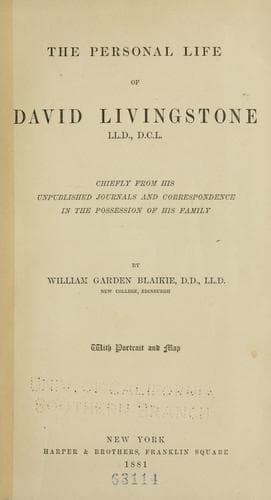
The Personal Life of David Livingstone: Chiefly from his Unpublished Journals and Correspondence in the Possession of His FamilyBlaikie, William Garden
Religion
The Personal Life of David Livingstone: Chiefly from his Unpublished Journals and Correspondence in the Possession of His Family
Blaikie, William Garden
Livingstone, David, 1813-1873
Through the great success of the volume and the handsome conduct of the
publishers, the book yielded him a little fortune. We shall see what
generous use he made of it--how large a portion of the profits went to
forward directly the great object to which his heart and his life were
so cordially given. More than half went to a single object connected
with the Zambesi Expedition, and of the remainder he was ready to devote
a half to another favorite project. All that he thought it his duty to
reserve for his children was enough to educate them, and prepare them
for their part in life. Nothing would have seemed less desirable or less
for their good than to found a rich family to live in idleness. It was
and is a common impression that Livingstone received large sums from
friends to aid him in his work. For the most part these impressions were
unfounded; but his own hard-earned money was bestowed freely and
cheerfully wherever it seemed likely to do good.
The complaint that he was not sufficiently a missionary was sometimes
made of his speeches as well as his book. At Carlisle, a lady wrote to
him in this strain. A copy of his reply is before us. After explaining
that reporters were more ready to report his geography than his
missionary views, he says:
"Nowhere have I ever appeared as anything else but a servant
of God, who has simply followed the leadings of his hand. My
views of what is _missionary_ duty are not so contracted as
those whose ideal is a dumpy sort of man with a Bible under
his arm. I have labored in bricks and mortar, at the forge
and carpenter's bench, as well as in preaching and medical
practice. I feel that I am 'not my own.' I am serving Christ
when shooting a buffalo for my men, or taking an astronomical
observation, or writing to one of his children who forget,
during the little moment of penning a note, that charity
which is eulogized as 'thinking no evil'; and after having by
his help got information, which I hope will lead to more
abundant blessing being bestowed on Africa than heretofore,
am I to hide the light under a bushel, merely because some
will consider it not sufficiently, or even at all,
_missionary_? Knowing that some persons do believe that
opening up a new country to the sympathies of Christendom was
not a proper work for an agent of a missionary society to
engage in, I now refrain from taking any salary from the
Society with which I was connected; so no pecuniary loss is
sustained by any one."
Subsequently, when detained in Manyuema, and when his immediate object
was to determine the water-shed, Dr. Livingstone wrote: "I never felt a
single pang at having left the Missionary Society. I acted for my
Master, and believe that all ought to devote their special faculties to
Him. I regretted that unconscientious men took occasion to prevent many
from sympathizing with me."
CHAPTER XI.
Public-domain text, read in full here on John Shaqi.
Reviews
Reviews
No reviews yet
Be the first to share your thoughts on this work.
Elsewhere in the archive
Join the Discussion
Join the discussion
Sign in to leave a comment or review.
Sign InorCreate an account