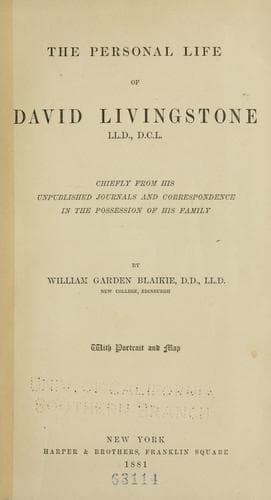
The Personal Life of David Livingstone: Chiefly from his Unpublished Journals and Correspondence in the Possession of His FamilyBlaikie, William Garden
Religion
The Personal Life of David Livingstone: Chiefly from his Unpublished Journals and Correspondence in the Possession of His Family
Blaikie, William Garden
Livingstone, David, 1813-1873
In September we find him in Manchester, where the Chamber of Commerce
gave him a hearty welcome, and entered cordially into his schemes for
the commercial development of Africa. He was subjected to a close
cross-examination regarding the products of the country, and the
materials it contained for commerce; but here, too, the missionary was
equal to the occasion. He had brought home five or six and twenty
different kinds of fruit; he told them of oils they had never heard
of--dyes that were kept secret by the natives--fibres that might be used
for the manufacture of paper--sheep that had hair instead of
wool--honey, sugar-cane, wheat, millet, cotton, and iron, all abounding
in the country. That all these should abound in what used to be deemed a
sandy desert appeared very strange. A very cordial resolution was
unanimously agreed to, and a strong desire expressed that Her Majesty's
Government would unite with that of Portugal in giving Dr. Livingstone
facilities for further exploration in the interior of Africa, and
especially in the district around the river Zambesi and its tributaries,
which promised to be the most suitable as a basis both for commercial
and missionary settlements.
In the course of the same month his foot was again on his native soil,
and there his reception was remarkably cordial. In Glasgow, the
University, the Corporation, the Faculty of Physicians and Surgeons, the
United Presbyterians, and the Associated Operative Cotton-spinners of
Scotland came forward to pay him honor. A testimonial of £2000 had been
raised by public subscription. The Corporation presented him with the
freedom of the city in a gold box, in acknowledging which he naturally
dwelt on some of the topics that were interesting to a commercial
community. He gave a somewhat new view of "Protection" when he called it
a remnant of heathenism. The heathen would be dependent on no one; they
would depress all other communities. Christianity taught us to be
friends and brothers, and he was glad that all restrictions on the
freedom of trade were now done away with. He dwelt largely on the
capacity of Africa to furnish us with useful articles of trade, and
especially cotton.
His reception by the Faculty of Physicians and Surgeons had a special
interest in relation to his medical labors. For nearly twenty years he
had been a licentiate of this Faculty, one of the oldest medical
institutions of the country, which for two centuries and a half had
exerted a great influence in the west of Scotland. He was now admitted
an honorary Fellow--an honor rarely conferred, and only on pre-eminently
distinguished men. The President referred to the benefit which he had
found from his scientific as well as his more strictly medical studies,
pursued under their auspices, and Livingstone cordially echoed the
remark, saying he often hoped that his sons might follow the same course
of study and devote themselves to the same noble profession:
Public-domain text, read in full here on John Shaqi.
Reviews
Reviews
No reviews yet
Be the first to share your thoughts on this work.
Elsewhere in the archive
Join the Discussion
Join the discussion
Sign in to leave a comment or review.
Sign InorCreate an account