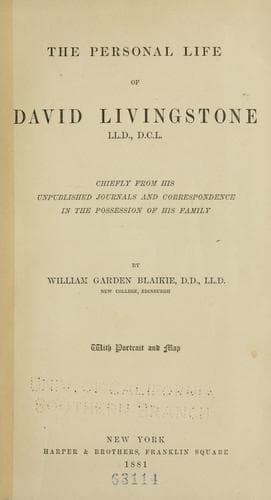
The Personal Life of David Livingstone: Chiefly from his Unpublished Journals and Correspondence in the Possession of His FamilyBlaikie, William Garden
Religion
The Personal Life of David Livingstone: Chiefly from his Unpublished Journals and Correspondence in the Possession of His Family
Blaikie, William Garden
Livingstone, David, 1813-1873
"My great object," he said, "was to be like Him--to imitate
Him as far as He could be imitated. We have not the power of
working miracles, but we can do a little in the way of
healing the sick, and I sought a medical education in order
that I might be like Him. In Africa I have had hard work. I
don't know that any one in Africa despises a man who works
hard. I find that all eminent men work hard. Eminent
geologists, mineralogists, men of science in every
department, if they attain eminence, work hard, and that both
early and late. That is just what we did. Some of us have
left the cotton-spinning, but I think that all of us who have
been engaged in that occupation look back on it with feelings
of complacency, and feel an interest in the course of our
companions. There is one thing in cotton-spinning that I
always felt to be a privilege. We were confined through the
whole day, but when we got out to the green fields, and could
wander through the shady woods, and rove about the whole
country, we enjoyed it immensely. We were delighted to see
the flowers and the beautiful scenery. We were prepared to
admire. We were taught by our confinement to rejoice in the
beauties of nature, and when we got out we enjoyed ourselves
to the fullest extent."
At Hamilton an interesting meeting took place in the Congregational
Chapel where he had been a worshiper in his youth. Here he was
emphatically at home; and he took the opportunity (as he often did) to
say how little he liked the lionizing he was undergoing, and how
unexpected all the honors were that had been showered upon him. He had
hoped to spend a short and quiet visit, and then return to his African
work. It was his sense of the kindness shown him, and the desire not to
be disobliging, that made him accept the public invitations he was
receiving. But he did not wish to take the honor to himself, as if he
had achieved anything by his own might or wisdom. He thanked God
sincerely for employing him as an instrument in his work. One of the
greatest honors was to be employed in winning souls to Christ, and
proclaiming to the captives of Satan the liberty with which he had come
to make them free. He was thankful that to him, "the least of all
saints," this honor had been given. He then proceeded to notice the
presence of members of various Churches, and to advert to the broadening
process that had been going on in his own mind while in Africa, which
made him feel himself more than ever the brother of all:
Public-domain text, read in full here on John Shaqi.
Reviews
Reviews
No reviews yet
Be the first to share your thoughts on this work.
Elsewhere in the archive
Join the Discussion
Join the discussion
Sign in to leave a comment or review.
Sign InorCreate an account