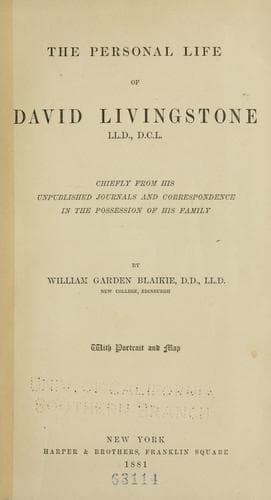
The Personal Life of David Livingstone: Chiefly from his Unpublished Journals and Correspondence in the Possession of His FamilyBlaikie, William Garden
Religion
The Personal Life of David Livingstone: Chiefly from his Unpublished Journals and Correspondence in the Possession of His Family
Blaikie, William Garden
Livingstone, David, 1813-1873
Before we come to the last adieus, it is well to glance at the
remarkable effect of Dr. Livingstone's short visit, in connection with
his previous labors, on the public opinion of the country in regard to
Africa. In the first place, as we have already remarked, there was quite
a revolution of ideas as to the interior of the country. It astonished
men to find that, instead of a vast sandy desert, it was so rich and
productive a land, and merchants came to see that if only a safe and
wholesome traffic could be introduced, the result would be hardly less
beneficial to them than to the people of Africa. In the second place, a
new idea was given of the African people. Caffre wars and other
mismanaged enterprises had brought out the wildest aspects of the native
character, and had led to the impression that the blacks were just as
brutish and ferocious as the tigers and crocodiles among which they
lived. But Livingstone showed, as Moffat had showed before him, that,
rightly dealt with, they were teachable and companionable, full of
respect for the white man, affectionate toward him when he treated them
well, and eager to have him dwelling among them. On the slave-trade of
the interior he had thrown a ghastly light, although it was reserved to
him in his future journeys to make a full exposure of the devil's work
in that infamous traffic. He had thrown light, too, on the structure of
Africa, shown where healthy localities were to be found, copiously
illustrated its fauna and flora, discovered great rivers and lakes, and
laid them down on its map with the greatest accuracy; and he had shown
how its most virulent disease might be reduced to the category of an
ordinary cold. In conjunction with other great African travelers, he had
contributed not a little to the great increase of popularity which had
been acquired by the Geographical Society. He had shown abundance of
openings for Christian missions from Kuruman to the Zambesi, and from
Loanda to Quilimane. He had excited no little compassion for the negro,
by vivid pictures of his dark and repulsive life, with so much misery in
it and so little joy. In the cause of missions he did not appeal in
vain. At the English Universities, young men of ability and promise got
new light on the purposes of life, and wondered that they had not
thought sooner of offering themselves for such noble work. In Scotland,
men like James Stewart, now of Lovedale, were set thinking whether they
should not give themselves to Africa, and older men, like Mr. R.A.
Macfie and the late Mr. James Cunningham, of Edinburgh, were pondering
in what manner the work could be begun. The London Missionary Society,
catching up Livingstone's watchword "Onward," were planning a mission at
Linyanti, on the banks of the Zambesi. Mr. Moffat was about to pay a
visit to the great Mosilikatse, with a view to the commencement of a
mission to the Matebele. As for Livingstone himself, his heart was
yearning after his friends the Makololo.
Public-domain text, read in full here on John Shaqi.
Reviews
Reviews
No reviews yet
Be the first to share your thoughts on this work.
Elsewhere in the archive
Join the Discussion
Join the discussion
Sign in to leave a comment or review.
Sign InorCreate an account