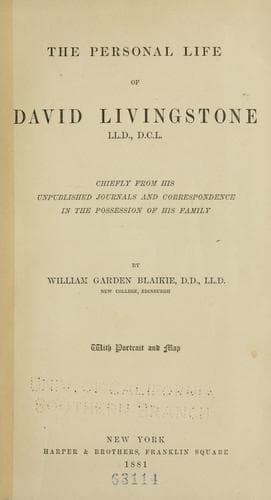
The Personal Life of David Livingstone: Chiefly from his Unpublished Journals and Correspondence in the Possession of His FamilyBlaikie, William Garden
Religion
The Personal Life of David Livingstone: Chiefly from his Unpublished Journals and Correspondence in the Possession of His Family
Blaikie, William Garden
Livingstone, David, 1813-1873
Moffat, who, with his wife, met them
at the Cape, that he had made out his visit to Mosilikatse, and had
learned that the men whom Livingstone had left at Tette had not returned
home, so that they would still be waiting for him there. He knew of what
value they would be to him in explaining his intentions to the natives.
From Sir George Grey, the excellent Governor of the Cape, and the
inhabitants of Cape Town generally, the Expedition met with an unusually
cordial reception. At a great meeting at the Exchange, a silver box
containing a testimonial of eight hundred guineas was presented to
Livingstone by the Governor; and two days after, a grand dinner was
given to the members of the Expedition, the Attorney-General being in
the chair. Mr. Maclear was most enthusiastic in the reception of his
friend, and at the public meeting had so much to say about him that he
could hardly be brought to a close. It must have been highly amusing to
Livingstone to contrast Cape Town in 1852 with Cape Town in 1858. In
1852 he was so suspected that he could hardly get a pound of gunpowder
or a box of caps while preparing for his unprecedented journey, and he
had to pay a heavy fine to get rid of a cantankerous post-master. Now he
returns with the Queen's gold band round his cap, and with brighter
decorations round his name than Sovereigns can give; and all Cape Town
hastens to honor him. It was a great victory, as it was also a striking
illustration of the world's ways.
It is not our object to follow Dr. Livingstone into all the details of
his Expedition, but merely to note a few of the more salient points, in
connection with the opportunities it afforded for the achievement of his
object and the development of his character. It may he well to note
here generally how the years were occupied. The remainder of 1858 was
employed in exploring the mouths of the Zambesi, and the river itself up
to Tette and the Kebrabasa Rapids, a few miles beyond. Next
year--1859--was devoted mainly to three successive trips on the river
Shiré, the third being signalized by the discovery of Lake Nyassa. In
1860 Livingstone went back with his Makololo up the Zambesi to the
territories of Sekelétu. In 1861, after exploring the river Rovuma, and
assisting Bishop Mackenzie to begin the Universities' Mission, he
started for Lake Nyassa, returning to the ship toward the end of the
year. In 1862 occurred the death of the Bishop and other missionaries,
and also, during a detention at Shupanga, the death of Mrs. Livingstone:
in the latter part of the year Livingstone again explored the Rovuma. In
1863 he was again exploring the Shiré Valley and Lake Nyassa, when an
order came from Her Majesty's Government, recalling the Expedition. In
1864 he started in the "Lady Nyassa" for Bombay, and thence returned
to England.
Public-domain text, read in full here on John Shaqi.
Reviews
Reviews
No reviews yet
Be the first to share your thoughts on this work.
Elsewhere in the archive
Join the Discussion
Join the discussion
Sign in to leave a comment or review.
Sign InorCreate an account