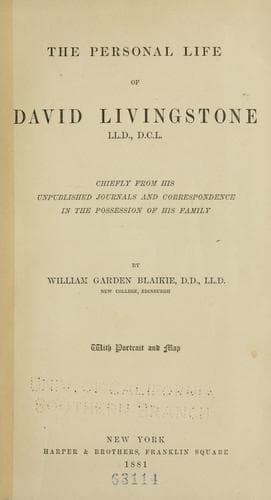
The Personal Life of David Livingstone: Chiefly from his Unpublished Journals and Correspondence in the Possession of His FamilyBlaikie, William Garden
Religion
The Personal Life of David Livingstone: Chiefly from his Unpublished Journals and Correspondence in the Possession of His Family
Blaikie, William Garden
Livingstone, David, 1813-1873
The idea of the colony quite fascinated Livingstone, and we find him
writing on it fully to three of his most confidential business
friends--Mr. Maclear, Mr. Young, and Sir Roderick Murchison. In all
Livingstone's correspondence we find the tone of his letters modified by
the character of his correspondents. While to Mr. Young and Sir Roderick
he is somewhat cautious on the subject of the colony, knowing the keen
practical eye they would direct on the proposal, to Mr. Maclear he is
more gushing. He writes to him:
"I feel such a gush of emotion on thinking of the great work
before us that I must unburden my mind. I am becoming every
day more decidedly convinced that English colonization is an
essential ingredient for our large success.... In this new
region of Highlands no end of good could be effected in
developing the trade in cotton and in discouraging that in
slaves.... You know how I have been led on from one step to
another by the overruling Providence of the great Parent, as
I believe, in order to a great good for Africa. 'Commit thy
way unto the Lord, trust also in Him, and He will bring it to
pass.' I have tried to do this, and now see the prospect in
front spreading out grandly.... But how is the land so
promising to be occupied?... How many of our home poor are
fighting hard to keep body and soul together! My heart yearns
over our own poor when I see so much of God's fair earth
unoccupied. Here it is really so; for the people have only a
few sheep and goats, and no cattle. I wonder why we cannot
have the old monastery system without the celibacy. In no
other part where I have been does the prospect of
self-support seem so inviting, and promising so much
influence. Most of what is done for the poor has especial
reference to the blackguard poor."
In his letter to Mr. Young he expressed his conviction that a great
desideratum in mission agency was missionary emigration by honest
Christian poor to give living examples of Christian life that would
insure permanency to the gospel once planted. He had always had a warm
side to the English and Scottish poor--his own order, indeed. If twenty
or thirty families would come out as an experiment, he was ready to give
£2000 without saying from whom. He bids Mr. Young speak about the plan
to Thorn of Chorley, Turner of Manchester, Lord Shaftesbury, and the
Duke of Argyll. "Now, my friend," he adds, "do your best, and God's
blessing be with you. Much is done for the blackguard poor. Let us
remember our own class, and do good while we have opportunity. I hereby
authorize you to act in my behalf, and do whatever is to be done without
hesitancy."
Public-domain text, read in full here on John Shaqi.
Reviews
Reviews
No reviews yet
Be the first to share your thoughts on this work.
Elsewhere in the archive
Join the Discussion
Join the discussion
Sign in to leave a comment or review.
Sign InorCreate an account