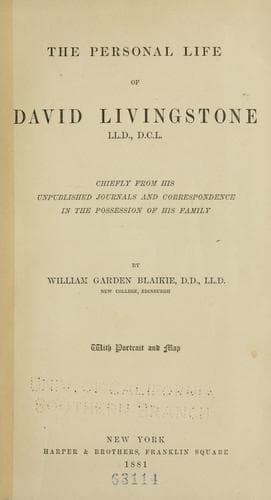
The Personal Life of David Livingstone: Chiefly from his Unpublished Journals and Correspondence in the Possession of His FamilyBlaikie, William Garden
Religion
The Personal Life of David Livingstone: Chiefly from his Unpublished Journals and Correspondence in the Possession of His Family
Blaikie, William Garden
Livingstone, David, 1813-1873
"I tell Lord John Russell that he (Rae) may thereby do us
more service than he can now do in a worn-out steamer, with
35 patches, covering at least 100 holes. I say to his
Lordship, that after we have, by patient investigation and
experiment, at the risk of life, rendered the fever not more
formidable than a common cold; found access, from a good
harbor on the coast, to the main stream; and discovered a
pathway into the magnificent Highland lake region, which
promises so fairly for our commerce in cotton, and for our
policy in suppressing the trade in slaves, I earnestly hope
that he will crown our efforts by securing our free passage
through those parts of the Zambesi and Shiré of which the
Portuguese make no use, and by enabling us to introduce
civilization in a manner which will extend the honor and
influence of the English name."
In his communications with the Government at home, Livingstone never
failed to urge the importance of their securing the free navigation of
the Zambesi. The Portuguese on the river were now beginning to get an
inkling of his drift, and to feel indignant at any countenance he was
receiving from their own Government.
Passing up the Zambesi with Charles Livingstone, Dr. Kirk, and such of
the Makololo as were willing to go home, Dr. Livingstone took a new look
at Kebrabasa, from a different point, still believing that in flood it
would allow a steamer to pass. Of his mode of traveling we have some
pleasant glimpses. He always tried to make progress more a pleasure than
a toil, and found that kindly consideration for the feelings even of
blacks, the pleasure of observing scenery and everything new, as one
moves on at an ordinary pace, and the participation in the most
delightful rest with his fellows, made traveling delightful. He was
gratified to find that he was as able for the fatigue as the natives.
Even the headman, who carried little more than he did himself, and
never, like him, hunted in the afternoon, was not equal to him. The
hunting was no small addition to the toil; the tired hunter was often
tempted to give it up, after bringing what would have been only
sufficient for the three whites, and leave the rest, thus sending "the
idle, ungrateful poor" supperless to bed. But this was not his way. The
blacks were thought of in hunting as well as the whites. "It is only by
continuance in well-doing," he says, "even to the length of what the
worldly-wise call weakness, that the conviction is produced anywhere,
that our motives are high enough to secure sincere respect."
Public-domain text, read in full here on John Shaqi.
Reviews
Reviews
No reviews yet
Be the first to share your thoughts on this work.
Elsewhere in the archive
Join the Discussion
Join the discussion
Sign in to leave a comment or review.
Sign InorCreate an account