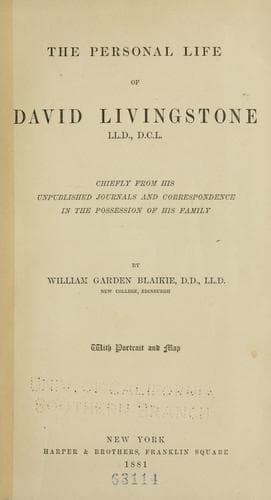
The Personal Life of David Livingstone: Chiefly from his Unpublished Journals and Correspondence in the Possession of His FamilyBlaikie, William Garden
Religion
The Personal Life of David Livingstone: Chiefly from his Unpublished Journals and Correspondence in the Possession of His Family
Blaikie, William Garden
Livingstone, David, 1813-1873
It is not often that missions are over-manned, but in the first stage of
such an undertaking as this, so large a body of men was an incumbrance,
none of them knowing a word of the language or a bit of the way. It was
Bishop Mackenzie's desire that Dr. Livingstone should accompany him at
once to the scene of his future labors and help him to settle. But
besides other reasons, the "Pioneer," as already stated, was under
orders to explore the Rovuma, and, as the Portuguese put so many
obstacles in the way on the Zambesi, to ascertain whether that river
might not afford access to the Nyassa district. It was at last arranged
that the Bishop should first go with the Doctor to the Rovuma, and
thereafter they should all go together to the Shiré. In waiting for
Bishop Mackenzie to accompany him, Dr. Livingstone lost the most
favorable part of the season, and found that he could not get with the
"Pioneer" to the top of the Rovuma. He might have left the ship and
pushed forward on foot; but, not to delay Bishop Mackenzie, he left the
Rovuma in the meantime, intending, after making arrangements with the
Bishop, to go to Nyassa, to find the point where the Rovuma left the
lake, if there were such a point, or, if not, get into its headwaters
and explore it downward.
Dr. Livingstone, as we have seen, welcomed the Mission right cordially,
for indeed it was what he had been most eagerly praying for, and he
believed that it would be the beginning of all blessing to Eastern and
Central Africa, and help to assimilate the condition of the East Coast
to that of the West The field for the cultivation of cotton which he had
discovered along the Shiré and Lake Nyassa was immense, above 400 miles
in length, and now it seemed as if commerce and Christianity were going
to take possession of it. But it was found that the turning-point of
prosperity had been reached, and it was his lot to encounter dark
reverses. The navigation of the Shiré was difficult, for the "Pioneer"
being deep in the water would often run aground. On these occasions the
Bishop, Mr. Scudamore, and Mr. Waller, the best and the bravest of the
missionary party, were ever ready with their help in hauling.
Livingstone was sometimes scandalized to see the Bishop toiling in the
hot sun, while some of his subordinates were reading or writing in the
cabin. As they proceeded up the Shiré it was seen that the promises of
assistance from the Portuguese Government were worse than fruitless.
Evidently the Portuguese traders were pushing the slave-trade with
greater eagerness than ever. Slave-hunting chiefs were marauding the
country, driving peaceful inhabitants before them, destroying their
crops, seizing on all the people they could lay hands on, and selling
them as slaves. The contrast to what Livingstone had seen on his last
journey was lamentable. All their prospects were overcast. How could
commerce or Christianity flourish in countries desolated by war?
Public-domain text, read in full here on John Shaqi.
Reviews
Reviews
No reviews yet
Be the first to share your thoughts on this work.
Elsewhere in the archive
Join the Discussion
Join the discussion
Sign in to leave a comment or review.
Sign InorCreate an account