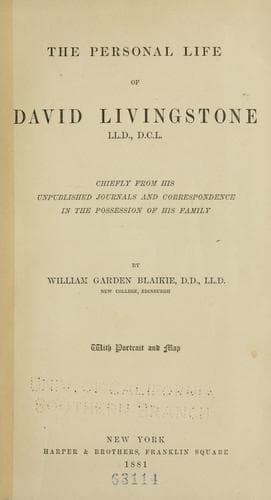
The Personal Life of David Livingstone: Chiefly from his Unpublished Journals and Correspondence in the Possession of His FamilyBlaikie, William Garden
Religion
The Personal Life of David Livingstone: Chiefly from his Unpublished Journals and Correspondence in the Possession of His Family
Blaikie, William Garden
Livingstone, David, 1813-1873
Their stock of goods being exhausted, and no provisions being
procurable, the party had to return at the end of October. They had to
abandon the project of getting from the lake to the Rovuma, and
exploring eastward. They reached the ship on 8th November, 1861, having
suffered more from hunger than on any previous trip.
In writing to his friend Young, 28th November, 1861, Livingstone
expresses his joy at the news of the departure of the "Lady Nyassa;"
gives him an account of the lake, and of a terrific storm in which they
were nearly lost; describes the inhabitants, and the terrible
slave-trade--the only trade that was carried on in the district. It will
take them the best part of a year to put the ship on the lake, but it
will be such a blessing! He hopes the Government will pay for it, once
it is there.
The colonization project had not commended itself to Sir R. Murchison.
He had written of it sometime before: "Your colonization scheme does not
meet with supporters, it being thought that you must have much more hold
on the country before you attract Scotch families to emigrate and settle
there, and then die off, or become a burden to you and all concerned,
like the settlers of old at Darien." It was with much satisfaction that
Livingstone now wrote to his friend (25th November, 1861): "A Dr.
Stewart is sent out by the Free Church of Scotland to confer with me
about a Scotch Colony. You will guess my answer. Dr. Kirk is with me in
opinion, and if I could only get you out to take a trip up to the
plateau of Zomba, and over the uplands which surround Lake Nyassa, you
would give in too."
When the party returned to the ship they had a visit from Bishop
Mackenzie, who was in good spirits and had excellent hopes of the
Mission. The Ajawa had been defeated, and had professed a desire to be
at peace with the English. But Dr. Livingstone was not without
misgivings on this point. The details of the defeat of the Ajawa, in
which the missionaries had taken an active part, troubled him, as we
find from his private Journal. "The Bishop," he says (14th of November),
"takes a totally different view of the affair from what I do." There
were other points on which the utter inexperience of the missionaries,
and want of skill in dealing with the natives, gave him serious anxiety.
It is impossible not to see that even thus early, the Mission, in
Livingstone's eyes, had lost something of its bloom.
It was arranged that the "Pioneer" should go down to the mouth of the
Zambesi, to meet a man-of-war with provisions, and bring up the pieces
of the new lake vessel, the "Lady Nyassa," which was eagerly expected,
along with Mrs. Livingstone, Miss Mackenzie, the Bishop's sister, and
other members of the Mission party. An appointment was made for January
at the mouth of the river Ruo, a tributary of the Shiré, where the
Bishop was to meet them. He and Mr. Burrup, who had just arrived, were
meanwhile to explore the neighboring country.
Public-domain text, read in full here on John Shaqi.
Reviews
Reviews
No reviews yet
Be the first to share your thoughts on this work.
Elsewhere in the archive
Join the Discussion
Join the discussion
Sign in to leave a comment or review.
Sign InorCreate an account