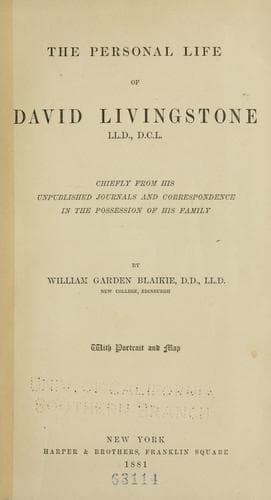
The Personal Life of David Livingstone: Chiefly from his Unpublished Journals and Correspondence in the Possession of His FamilyBlaikie, William Garden
Religion
The Personal Life of David Livingstone: Chiefly from his Unpublished Journals and Correspondence in the Possession of His Family
Blaikie, William Garden
Livingstone, David, 1813-1873
aside from the direct objects of his own enterprise by having to look
after so many inexperienced men, and then blamed for what he deprecated,
and what was done in his absence, was rather more than it was reasonable
for him to bear[65].
[Footnote 63: Writing to Mr. Waller, 12th February, 1863, Dr.
Livingstone said: "I thought you wrong in attacking the Ajawa, till I
looked on it as defense of your orphans. I thought that you had shut
yourselves up to one tribe, and that, the Manganja; but I think
differently now, and only wish they would send out Dr. Pusey here. He
would learn a little sense, of which I suppose I have need myself."]
[Footnote 64: Mr. Rowley afterward (February 22, 1865) expressed his
regret that this letter was ever written, as it had produced an
ill-effect. See _The Zambesi and its Tributaries_, p. 475 _note_.]
[Footnote 65: It must not be supposed that the letter of Mr. Rowley
expressed the mind of his brethren. Some of them were greatly annoyed at
it, and used their influence to induce its author to write to the Cape
papers that he had conveyed a wrong impression. In writing to Sir Thomas
Maclear (20th November, 1862), after seeing Rowley's letter in the Cape
papers, Dr. Livingstone said: "It is untrue that I ever on anyone
occasion adopted an aggressive policy against the Ajawa, or took slaves
from them. Slaves were taken from Portuguese alone. I never hunted the
Ajawa, or took the part of Manganja against Ajawa. In this I believe
every member of the Mission will support my assertion." Livingstone
declined to write a contradiction _to the public prints_, because he
knew the harm that would be done by a charge against a clergyman. In
this he showed the same magnanimity and high Christian self-denial which
he had shown when he left Mabotsa. It was only when the Portuguese
claimed the benefit of Rowley's testimony that he let the public see
what its value was.]
Writing of the terrible loss of Mackenzie and Burrup to the Bishop of
Cape Town, Livingstone says: "The blow is quite bewildering; the two
strongest men so quickly cut down, and one of them, humanly speaking,
indispensable to the success of the enterprise. We must bow to the will
of Him who doeth all things well; but I cannot help feeling sadly
disturbed in view of the effect the news may have at home. _I shall not
swerve a hairbreadth from my work while life is spared_, and I trust
the supporters of the Mission may not shrink back from all that they
have set their hearts to."
The next few weeks were employed in taking Miss Mackenzie and Mrs.
Burrup to the "Gorgon" on their way home. It was a painful voyage to
all--to Dr. and Mrs. Livingstone, to Miss Mackenzie and Mrs. Burrup, and
last, not least, to Captain Wilson, who had been separated so long from
his ship, and had risked life, position, and everything, to do service
to a cause which in spite of all he left at a much lower ebb.
Public-domain text, read in full here on John Shaqi.
Reviews
Reviews
No reviews yet
Be the first to share your thoughts on this work.
Elsewhere in the archive
Join the Discussion
Join the discussion
Sign in to leave a comment or review.
Sign InorCreate an account