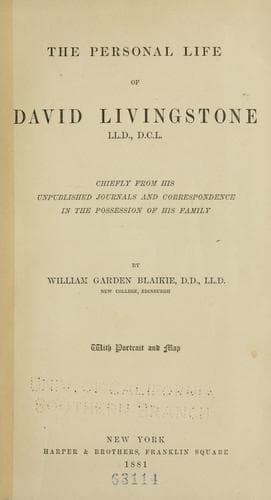
The Personal Life of David Livingstone: Chiefly from his Unpublished Journals and Correspondence in the Possession of His FamilyBlaikie, William Garden
Religion
The Personal Life of David Livingstone: Chiefly from his Unpublished Journals and Correspondence in the Possession of His Family
Blaikie, William Garden
Livingstone, David, 1813-1873
The state of the country continued so disturbed that it was not till
February, 1843, that he was able to set out for the village where
Sebehwe had taken up his residence with the remains of his tribe. This
visit he undertook at great personal risk. Though looking at first very
ill-pleased, Sebehwe treated him in a short time in a most friendly way,
and on the Sunday after his arrival, sent a herald to proclaim that on
that day nothing should be done but pray to God and listen to the words
of the foreigner. He himself listened with great attention while
Livingstone told him of Jesus and the resurrection, and the missionary
was often interrupted by the questions of the chief. Here, then, was
another chief pacified, and brought under the preaching of the gospel.
Livingstone then passed on to the country of the Bakhatla, where he had
purposed to erect his mission-station. The country was fertile, and the
people industrious, and among other industries was an iron manufactory,
to which as a bachelor he got admission, whereas married men were wont
to be excluded, through fear that they would bewitch the iron! When he
asked the chief if he would like him to come and be his missionary, he
held up his hands and said, "Oh, I shall dance if you do; I shall
collect all my people to hoe for you a garden, and you will get more
sweet reed and corn than myself." The cautious Directors at home,
however, had sent no instructions as to Livingstone's station, and he
could only say to the chief that he would tell them of his desire for a
missionary.
At a distance of five days' journey beyond the Bakhatla was situated the
village of Sechéle, chief of the Bakwains, afterward one of
Livingstone's greatest friends. Sechéle had been enraged at him for not
visiting him the year before, and threatened him with mischief. It
happened that his only child was ill when the missionary arrived, and
also the child of one of his principal men. Livingstone's treatment of
both was successful, and Sechéle had not an angry word. Some of his
questions struck the heart of the missionary:
Public-domain text, read in full here on John Shaqi.
Reviews
Reviews
No reviews yet
Be the first to share your thoughts on this work.
Elsewhere in the archive
Join the Discussion
Join the discussion
Sign in to leave a comment or review.
Sign InorCreate an account