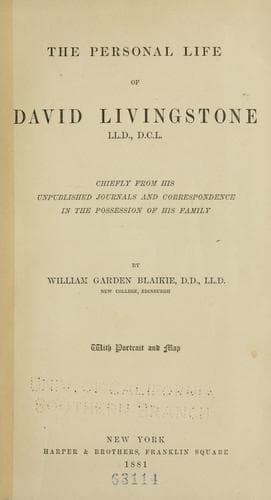
The Personal Life of David Livingstone: Chiefly from his Unpublished Journals and Correspondence in the Possession of His FamilyBlaikie, William Garden
Religion
The Personal Life of David Livingstone: Chiefly from his Unpublished Journals and Correspondence in the Possession of His Family
Blaikie, William Garden
Livingstone, David, 1813-1873
Describing what was to be his new home to his friend Watt from Kuruman,
27th September, 1843, Livingstone says: "The Bakhatla have cheerfully
offered to remove to a more favorable position than they at present
occupy. We have fixed upon a most delightful valley, which we hope to
make the centre of our sphere of operations in the interior. It is
situated in what poetical gents like you would call almost an
amphitheatre of mountains. The mountain range immediately in the rear of
the spot where we have fixed our residence is called Mabotsa, or a
marriage-feast. May the Lord lift upon us the light of his countenance,
so that by our feeble instrumentality many may thence be admitted to the
marriage-feast of the Lamb. The people are as raw as may well be
imagined; they have not the least desire but for the things of the
earth, and it must be a long time ere we can gain their attention to the
things which are above."
Something led him in his letter to Mr. Watt to talk of the old monks,
and the spots they selected for their establishments. He goes on to
write lovingly of what was good in some of the old fathers of the
mediæval Church, despite the strong feeling of many to the contrary;
indicating thus early the working of that catholic spirit which was
constantly expanding in later years, which could separate the good in
any man from all its evil surroundings, and think of it thankfully and
admiringly. In the following extract we get a glimpse of a range of
reading much wider than most would probably have supposed likely:
"Who can read the sermons of St. Bernard, the meditations of
St. Augustine, etc., without saying, whatever other faults
they had: They thirsted, and now they are filled. That hymn:
of St. Bernard, on the name of Christ, although in what might
he termed dog-Latin, pleases me so; it rings in my ears as I
wander across the wide, wide wilderness, and makes me wish I
was more like them--
"Jesu, dulcis memoria, Jesu, spes poenitentibus,
Dans cordi vera gaudia; Quam pius es petentibus!
Sed super mel et omnia, Quam bonus es quærentibus!
Ejus dulcis præsentia. Sed quid invenientibus!
Nil canitur suavius, Jesu, dulcedo cordium,
Nil auditur jucundius, Fons, rivus, lumen mentium,
Nil cogitatur dulcius, Excedens omne gaudium,
Quam Jesus Dei filius. Et omne desiderium."
Livingstone was in the habit of fastening inside the boards of his
journals, or writing on the fly-leaf, verses that interested him
specially. In one of these volumes this hymn is copied at full length.
In another we find a very yellow newspaper clipping of the "Song of the
Shirt." In the same volume a clipping containing "The Bridge of
Sighs," beginning
"One more unfortunate,
Weary of breath,
Rashly importunate,
Gone to her death."
In another we have Coleridge's lines:
Public-domain text, read in full here on John Shaqi.
Reviews
Reviews
No reviews yet
Be the first to share your thoughts on this work.
Elsewhere in the archive
Join the Discussion
Join the discussion
Sign in to leave a comment or review.
Sign InorCreate an account