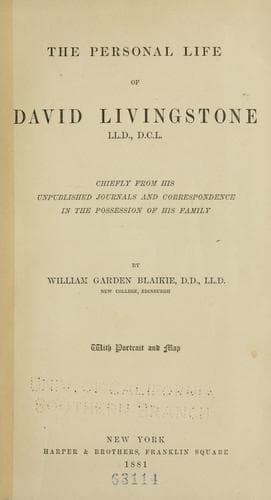
The Personal Life of David Livingstone: Chiefly from his Unpublished Journals and Correspondence in the Possession of His FamilyBlaikie, William Garden
Religion
The Personal Life of David Livingstone: Chiefly from his Unpublished Journals and Correspondence in the Possession of His Family
Blaikie, William Garden
Livingstone, David, 1813-1873
Another proof that his pleas for native agency, published in some of the
Missionary Magazines, were telling at home, was the receipt of a
contribution for the employment of a native helper, amounting to £15,
from a Sunday-school in Southampton. Touched with this proof of youthful
sympathy, Livingstone addressed a long letter of thanks to the
Southampton teachers and children, desiring to deepen their interest in
the work, and concluding with an account of his Sunday-school:
"I yesterday commenced school for the first time at Mabotsa,
and the poor little naked things came with fear and
trembling. A native teacher assisted, and the chief collected
as many of them as he could, or I believe we should have had
none. The reason is, the women make us the hobgoblins of
their children, telling them 'these white men bite children,
feed them with dead men's brains, and all manner of nonsense.
We are just commencing our mission among them."
A new star now appeared in Livingstone's horizon, destined to give a
brighter complexion to his life, and a new illustration to the name
Mabotsa. Till this year (1844) he had steadily repudiated all thoughts
of marriage, thinking it better to be independent. Nor indeed had he met
with any one to induce him to change his mind. Writing in the end of
1843 to his friend Watt, he had said: "There's no outlet for me when I
begin to think of getting married but that of sending home an
advertisement to the _Evangelical Magazine_, and if I get very old, it
must be for some decent sort of widow. In the meantime I am too busy to
think of any thing of the kind." But soon after the Moffats came back
from England to Kuruman, their eldest daughter Mary rapidly effected a
revolution in Livingstone's ideas of matrimony. They became engaged. In
announcing his approaching marriage to the Directors, he makes it plain
that he had carefully considered the bearing which this step might have
on his usefulness as a missionary. No doubt if he had foreseen the very
extraordinary work to which he was afterwards to be called, he might
have come to a different conclusion. But now, apparently, he was fixed
and settled. Mabotsa would become a centre from which native missionary
agents would radiate over a large circumference. His own life-work would
resemble Mr. Moffat's. For influencing the women and children of such a
place, a Christian lady was indispensable, and who so likely to do it
well as one born in Africa, the daughter of an eminent and honored
missionary, herself familiar with missionary life, and gifted with the
winning manner and the ready helping hand that were so peculiarly
adapted for this work? The case was as clear as possible, and
Livingstone was very happy.
Public-domain text, read in full here on John Shaqi.
Reviews
Reviews
No reviews yet
Be the first to share your thoughts on this work.
Elsewhere in the archive
Join the Discussion
Join the discussion
Sign in to leave a comment or review.
Sign InorCreate an account