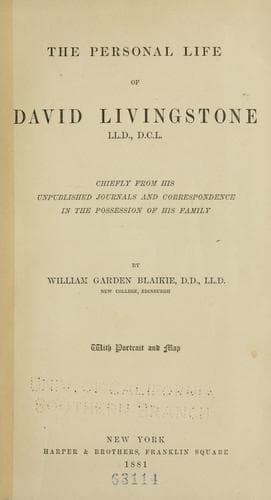
The Personal Life of David Livingstone: Chiefly from his Unpublished Journals and Correspondence in the Possession of His FamilyBlaikie, William Garden
Religion
The Personal Life of David Livingstone: Chiefly from his Unpublished Journals and Correspondence in the Possession of His Family
Blaikie, William Garden
Livingstone, David, 1813-1873
learning.... Your family increases, very fast, and I fear we follow in
your wake. I cannot realize the idea of your sitting with four around
you, and I can scarcely believe myself to be so far advanced as to be
the father of two."
Livingstone never expected the work of real Christianity to advance
rapidly among the Bakwains. They were a slow people and took long to
move. But it was not his desire to have a large church of nominal
adherents. "Nothing," he writes, "will induce me to form an impure
church. Fifty added to the church sounds fine at home, but if only five
of these are genuine, what will it profit in the Great Day? I have felt
more than ever lately that the great object of our exertions ought to be
conversion." There was no subject on which Livingstone had stronger
feelings than on purity of communion. For two whole years he allowed no
dispensation of the Lord's Supper, because he did not deem the
professing Christians to be living consistently. Here was a crowning
proof of his hatred of all sham and false pretense, and his intense love
of solid, thorough, finished work.
Hardly were things begun to be settled at Kolobeng, when, by way of
relaxation, Livingstone (January, 1848) again moved eastward. He would
have gone sooner, but "a mad sort of Scotchman[26]," having wandered
past them shooting elephants, and lost all his cattle by the bite of the
tsetse-fly, Livingstone had to go to his help; and moreover the dam,
having burst, required to be repaired. Sechéle set out to accompany him,
and intended to go with him the whole way; but some friends having come
to visit his tribe, he had to return, or at least did return, leaving
Livingstone four gallons of porridge, and two servants to act in his
stead. "He is about the only individual," says Livingstone, "who
possesses distinct, consistent views on the subject of our mission. He
is bound by his wives: has a curious idea--would like to go to another
country for three or four years in order to study, with the hope that
probably his wives would have married others in the meantime. He would
then return, and be admitted to the Lord's Supper, and teach his people
the knowledge he has acquired, He seems incapable of putting them away.
He feels so attached to them, and indeed we, too, feel much attached to
most of them. They are our best scholars, our constant friends. We
earnestly pray that they, too, may be enlightened by the Spirit of God."
[Footnote 26: Mr. Gordon Cumming.]
The prayer regarding Sechéle was answered soon. Reviewing the year 1844
in a letter to the Directors, Livingstone says: "An event that excited
more open enmity than any other was the profession of faith and
subsequent reception of the chief into the church."
Public-domain text, read in full here on John Shaqi.
Reviews
Reviews
No reviews yet
Be the first to share your thoughts on this work.
Elsewhere in the archive
Join the Discussion
Join the discussion
Sign in to leave a comment or review.
Sign InorCreate an account