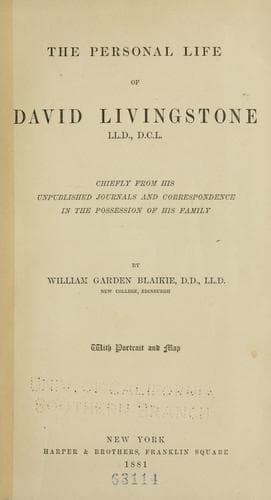
The Personal Life of David Livingstone: Chiefly from his Unpublished Journals and Correspondence in the Possession of His FamilyBlaikie, William Garden
Religion
The Personal Life of David Livingstone: Chiefly from his Unpublished Journals and Correspondence in the Possession of His Family
Blaikie, William Garden
Livingstone, David, 1813-1873
"I cannot perform impossibilities," said Livingstone; but few men could
come so near doing it. His activity of mind and body at this outskirt of
civilization was wonderful. A Jack-of-all-trades, he is building houses
and schools, cultivating gardens, scheming in every manner of way how to
get water, which in the remarkable drought of the season becomes scarcer
and scarcer; as a missionary he is holding meetings every other night,
preaching on Sundays, and taking such other opportunities as he can find
to gain the people to Christ; as a medical man he is dealing with the
more difficult cases of disease, those which baffle the native doctors;
as a man of science he is taking observations, collecting specimens,
thinking out geographical, geological, meteorological, and other
problems bearing on the structure and condition of the continent; as a
missionary statesman he is planning how the actual force might be
disposed of to most advantage, and is looking round in this direction
and in that, over hundreds of miles, for openings for native agents; and
to promote these objects he is writing long letters to the Directors, to
the _Missionary Chronicle_ to the _British Banner_, to private friends,
to any one likely to take an interest in his plans.
But this does not exhaust his labors. He is deeply interested in
philological studies, and is writing on the Sichuana language:
"I have been hatching a grammar of the Sichuana language," he
writes to Mr. Watt. "It is different in structure from any
other language, except the ancient Egyptian. Most of the
changes are effected by means of prefixes or affixes, the
radical remaining unchanged. Attempts have been made to form
grammars, but all have gone on the principle of establishing
a resemblance between Sichuana, Latin, and Greek; mine is on
the principle of analysing the language without reference to
any others. Grammatical terms are only used when I cannot
express my meaning in any other way. The analysis renders the
whole language very simple, and I believe the principle
elicited extends to most of the languages between this and
Egypt. I wish to know whether I could get 20 or 30 copies
printed for private distribution at an expense not beyond my
means. It would be a mere tract, and about the size of this
letter when folded, 40 or 50 pages perhaps[28]. Will you
ascertain the cost, and tell me whether, in the event of my
continuing hot on the subject half a year hence, you would be
the corrector of the press?... Will you examine catalogues to
find whether there is any dictionary of ancient Egyptian
within my means, so that I might purchase and compare? I
should not grudge two or three pounds for it. Professor Vater
has written on it, but I do not know what dictionary he
consulted. One Tattam has written a Coptic grammar; perhaps
that has a vocabulary, and might serve my purpose.
Public-domain text, read in full here on John Shaqi.
Reviews
Reviews
No reviews yet
Be the first to share your thoughts on this work.
Elsewhere in the archive
Join the Discussion
Join the discussion
Sign in to leave a comment or review.
Sign InorCreate an account