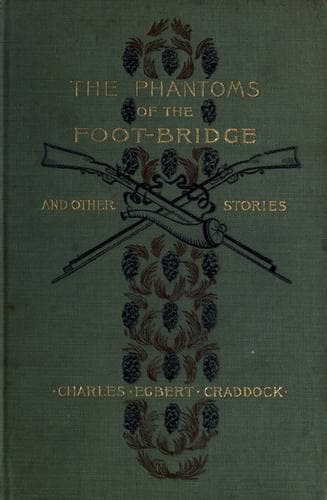
The Phantoms of the Foot-Bridge, and Other StoriesCraddock, Charles Egbert
General
The Phantoms of the Foot-Bridge, and Other Stories
Craddock, Charles Egbert
Cumberland Mountains -- Fiction; Mountain life -- Fiction; Tennessee -- Social life and customs -- Fiction
After another refreshing gulp from the gourd he canvassed this
dispassionately. "Say his own chil'n air 'hearty feeders an' hard on
shoe-leather?' Takes a good deal o' goadin' ter git ploughin' enough fur
the wuth o' feed out'n a toler'ble beastis like old Blaze-face thar,
don't it, Neighbor?--an' how is it a-goin' ter be with a human ez mebbe
will hold back an' air sot agin ploughin' ennyhow, an' air sorter idle
by profession? 'Twould gin him a heap o' trouble--more'n the ploughin'
an' sech would be wuth--a heap o' trouble." Once more he bowed his head
to the gourd.
"He 'lowed ye shouldn't dwell no mo' in the tents o' sin. He seen the
fiddle, Lee; it's all complicated with the fiddle," she quavered, very
near tears of vexation.
He lifted a smiling moonlit face; his half-suppressed laugh echoed
gurglingly in the gourd. "Cap'n," he said, reassuringly, "jes let's hear
Uncle Nehemiah talk some mo', an' ef I can't see no mo' likely work fur
me 'n ploughin', I'll think myself mighty safe."
They felt like three conspirators as after supper they drew their chairs
around the fire with the unsuspicious Uncle Nehemiah. However, Nehemiah
Yerby could hardly be esteemed unsuspicious in any point of view, so
full of vigilant craft was his intention in every anticipation, so
slyly sanctimonious was his long countenance.
There could hardly have been a greater contrast than Tyler Sudley's
aspect presented. His candid face seemed a mirror for his thought; he
had had scant experience in deception, and he proved a most unlikely
novice in the art. His features were heavy and set; his manner was
brooding and depressed; he did not alertly follow the conversation; on
the contrary, he seemed oblivious of it as his full dark eyes rested
absently on the fire. More than once he passed his hand across them with
a troubled, harassed manner, and he sighed heavily. For which his
co-conspirators could have fallen upon him. How could he be so dull, so
forgetful of all save the fear of separation from the boy whom he had
reared, whom he loved as his own son; how could he fail to know that a
jaunty, assured mien might best serve his interests until at any rate
the blow had fallen; why should he wear the insignia of defeat before
the strength of his claim was tested? Assuredly his manner was
calculated to greatly reinforce Nehemiah Yerby's confidence, and to
assist in eliminating difficulties in the urging of his superior rights
and the carrying out of his scheme. Mrs. Sudley's heart sank as she
caught a significant gleam from the boy's eyes; he too appreciated this
disastrous policy, this virtual surrender before a blow was struck.
"An' Ty ain't afeard o' bars," she silently commented, "nor wolves, nor
wind, nor lightning, nor man in enny kind o' a free fight; but bekase he
dun'no' how the _law_ stands, an' air afeard the law _mought_ be able
ter take Lee-yander, he jes sets thar ez pitiful ez a lost kid, fairly
ready ter blate aloud."
Public-domain text, read in full here on John Shaqi.
Reviews
Reviews
No reviews yet
Be the first to share your thoughts on this work.
Elsewhere in the archive
Join the Discussion
Join the discussion
Sign in to leave a comment or review.
Sign InorCreate an account