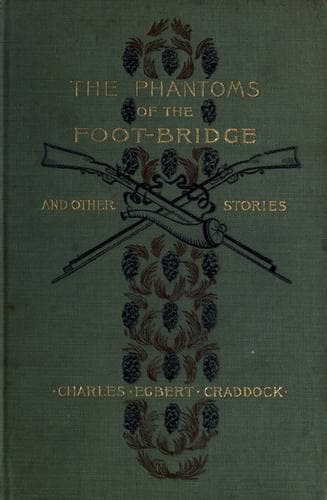
The Phantoms of the Foot-Bridge, and Other StoriesCraddock, Charles Egbert
General
The Phantoms of the Foot-Bridge, and Other Stories
Craddock, Charles Egbert
Cumberland Mountains -- Fiction; Mountain life -- Fiction; Tennessee -- Social life and customs -- Fiction
This much Nehemiah beheld, and naught else, for the glittering profile
of the falls, visible now only aslant, the dark, cool recess beyond,
that menacing motionless figure at the vanishing-point of the
perspective, all blended together in an indistinguishable whirl as his
senses reeled. He barely retained consciousness enough to throw up both
his hands in token of complete submission. And then for a moment he knew
no more. He was still leaning motionless against the wall of rock when
he became aware that the man was sternly beckoning to him to continue
his approach. His dumb lips moved mechanically in response, but any
sound must needs have been futile indeed in the pervasive roar of the
waters. He felt that he had hardly strength for another step along the
precipitous way, but there is much tonic influence in a beckoning
revolver, and few men are so weak as to be unable to obey its behests.
Poor Nehemiah tottered along as behooved him, leaving all the world,
liberty, volition, behind him as the descending sheet of water fell
between him and the rest of life and shut him off.
"That's it, my leetle man! I thought you could make it!" were the first
words he could distinguish as he joined the mountaineer beneath the
crag.
Nehemiah Yerby had never before seen this man. That in itself was
alarming, since in the scanty population of the region few of its
denizens are unknown to each other, at least by sight. The tone of
satire, the gleam of enjoyment in his keen blue eye, were not
reassuring to the object of his ridicule. He was tall and somewhat
portly, and he had a bluff and offhand manner, which, however, served
not so much to intimate his good-will toward you as his abounding
good-humor with himself. He was a man of most arbitrary temper, one
could readily judge, not only from his own aspect and manner, but from
the docile, reliant, approving cast of countenance of his reserve
force--a half-dozen men, who were somewhat in the background, lounging
on the rocks about a huge copper still. They wore an attentive aspect,
but offered to take no active part in the scene enacted before them. One
of them--even at this crucial moment Yerby noticed it with a pang of
regretful despair--held noiseless on his knee a violin, and more than
once addressed himself seriously to rubbing rosin over the bow. There
was scant music in his face--a square physiognomy, with thick features,
and a shock of hay-colored hair striped somewhat with an effect of
darker shades like a weathering stack. He handled the bow with a blunt,
clumsy hand that augured little of delicate skill, and he seemed from
his diligence to think that rosin is what makes a fiddle play. He was
evidently one of those unhappy creatures furnished with some vague inner
attraction to the charms of music, with no gift, no sentiment, no
discrimination. Something faintly sonorous there was in his soul, and it
vibrated to the twanging of the strings. He was far less alert to the
Public-domain text, read in full here on John Shaqi.
Reviews
Reviews
No reviews yet
Be the first to share your thoughts on this work.
Elsewhere in the archive
Join the Discussion
Join the discussion
Sign in to leave a comment or review.
Sign InorCreate an account