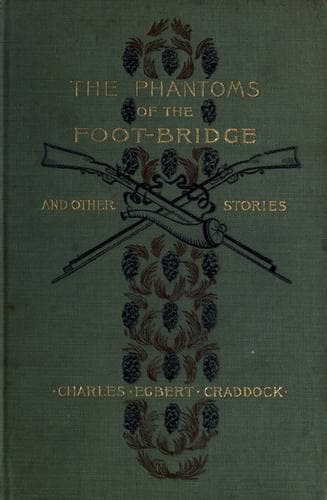
The Phantoms of the Foot-Bridge, and Other StoriesCraddock, Charles Egbert
General
The Phantoms of the Foot-Bridge, and Other Stories
Craddock, Charles Egbert
Cumberland Mountains -- Fiction; Mountain life -- Fiction; Tennessee -- Social life and customs -- Fiction
Presently there were cinders flying in the breeze, a smell of smoke
pervaded the air, and the ranger forgot to curse the mare when she
stumbled.
"I wonder," he muttered, "what them no 'count half-livers o' town folks
hev hed the shiftlessness ter let ketch afire thar!"
As he neared the brink of the mountain he saw a dense column of smoke
against the sky, and a break in the woods showed the little town--the
few log houses, the "gyarden spots" about them, and in the centre of the
Square a great mass of coals, a flame flickering here and there, and two
gaunt and tottering chimneys where once the court-house had stood. At
some distance--for the heat was still intense--were grouped the
slouching, spiritless figures of the mountaineers. On the porches of the
houses, plainly visible in the unwonted red glow, were knots of women
and children--ever and anon a brat in the scantiest of raiment ran
nimbly in and out. The clouds still borrowed the light from below, and
the solemn, leafless woods on one side were outlined distinctly against
the reflection in the sky. The flare showed, too, the abrupt precipice
on the other side, the abysmal gloom of the valley, the austere
summit-line of the mountain beyond, and gave the dark mysteries of the
night a sombre revelation, as in visible blackness it filled the
illimitable space.
The little mare was badly blown as the ranger sprang to the ground. He
himself was panting with amazement and eagerness.
"The stray-book!" he cried. "Whar's the stray-book?"
One by one the slow group turned, all looking at him with a peering
expression as he loomed distorted through the shimmer of the heat above
the bed of live coals and the hovering smoke.
"Whar's the stray-book?" he reiterated, imperiously.
"Whar's the court-house, I reckon ye mean to say," replied the
sheriff--a burly mountaineer in brown jeans and high boots, on which the
spurs jingled; for in his excitement he had put them on as mechanically
as his clothes, as if they were an essential part of his attire.
"Naw, I _ain't_ meanin' ter say whar's the court-house," said the
ranger, coming up close, with the red glow of the fire on his face, and
his eyes flashing under the broad brim of his wool hat. He had a
threatening aspect, and his elongated shadow, following him and
repeating the menace of his attitude, seemed to back him up. "Ye air
sech a triflin', slack-twisted tribe hyar in town, ez ennybody would
know ef a spark cotched fire ter suthin, ye'd set an' suck yer paws, an'
eye it till it bodaciously burnt up the court-house--sech a dad-burned
lazy set o' half-livers ye be! I never axed 'bout'n the court-house. I
want ter know whar's that thar stray-book," he concluded,
inconsequently.
Public-domain text, read in full here on John Shaqi.
Reviews
Reviews
No reviews yet
Be the first to share your thoughts on this work.
Elsewhere in the archive
Join the Discussion
Join the discussion
Sign in to leave a comment or review.
Sign InorCreate an account