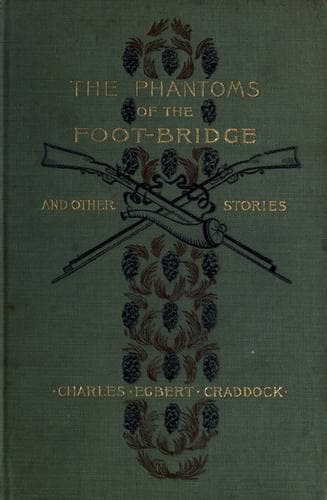
The Phantoms of the Foot-Bridge, and Other StoriesCraddock, Charles Egbert
General
The Phantoms of the Foot-Bridge, and Other Stories
Craddock, Charles Egbert
Cumberland Mountains -- Fiction; Mountain life -- Fiction; Tennessee -- Social life and customs -- Fiction
The footfalls of the little black mare annotated the silence of the
place as he rode away into the darkling woods. The groups gradually
disappeared from the porches. The few voices that sounded at long
intervals were low and drowsy. The red fire smouldered in the centre of
the place, and sometimes about it appeared so doubtful a shadow that it
could hardly argue substance. Far away a dog barked, and then all was
still.
Presently the great mountains loom aggressively along the horizon. The
black abysses, the valleys and coves, show duncolored verges and grow
gradually distinct, and on the slopes the ash and the pine and the oak
are all lustrous with a silver rime. The mists are rising, the wind
springs up anew, the clouds set sail, and a beam slants high.
* * * * *
"What I want ter know," said a mountaineer newly arrived on the scene,
sitting on the verge of the precipice, and dangling his long legs over
the depths beneath, "air how do folks ez live 'way down in Lonesome
Cove, an' who nobody knowed nuthin about noways, ever git 'lected ranger
o' the county, ennyhow. I ain't s'prised none ter hear 'bout Tobe
Gryce's goin's-on hyar las' night. I hev looked fur more'n that."
"Wa'al, I'll tell ye," replied the register. "Nuthin' but favoritism in
the county court. Ranger air 'lected by the jestices. Ye know," he
added, vainglorious of his own tenure of office by the acclaiming voice
of the sovereign people, "ranger ain't 'lected, like the register, by
pop'lar vote."
A slow smoke still wreathed upward from the charred ruins of the
court-house. Gossiping groups stood here and there, mostly the
jeans-clad mountaineers, but there were a few who wore "store clothes,"
being lawyers from more sophisticated regions of the circuit. Court had
been in session the previous day. The jury, serving in a criminal
case--still strictly segregated, and in charge of an officer--were
walking about wearily in double file, waiting with what patience they
might their formal discharge.
The sheriff's dog, a great yellow cur, trotted in the rear. When the
officer was first elected, this animal, observing the change in his
master's habits, deduced his own conclusions. He seemed to think the
court-house belonged to the sheriff, and thence-forward guarded the door
with snaps and growls; being a formidable brute, his idiosyncrasies
invested the getting into and getting out of law with abnormal
difficulties. Now, as he followed the disconsolate jury, he bore the
vigilant mien with which he formerly drove up the cows, and if a juror
loitered or stepped aside from the path, the dog made a slow detour as
if to round him in, and the melancholy cortége wandered on as before.
More than one looked wistfully at the group on the crag, for it was
distinguished by that sprightly interest which scandal excites so
readily.
Public-domain text, read in full here on John Shaqi.
Reviews
Reviews
No reviews yet
Be the first to share your thoughts on this work.
Elsewhere in the archive
Join the Discussion
Join the discussion
Sign in to leave a comment or review.
Sign InorCreate an account