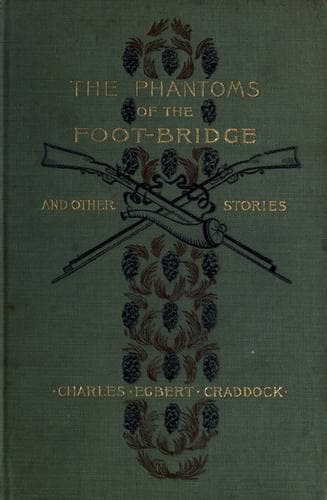
The Phantoms of the Foot-Bridge, and Other StoriesCraddock, Charles Egbert
General
The Phantoms of the Foot-Bridge, and Other Stories
Craddock, Charles Egbert
Cumberland Mountains -- Fiction; Mountain life -- Fiction; Tennessee -- Social life and customs -- Fiction
The ranger's black eyes were wide with wonder at this intrusion, and
angrily flashed. He connected it at once with the attack on the stable.
The hair on his low forehead rose bristlingly as he frowned. Yet he
realized with a quaking heart that he was helpless. He, although the
crack shot of the county, would not have fired while the Colonel was
within two yards of his mark for the State of Tennessee.
He stood his ground with stolid courage--a target.
Then, with a start of surprise, he perceived that the intruder was
unarmed. Twenty feet away his rifle stood against the wall.
Tobe Gryce was strangely shaken. He experienced a sudden revolt of
credulity. This was surely a dream.
"Ain't that thar Luke Todd? Why air ye a-waitin' thar?" he called out in
a husky undertone.
Todd glanced up, and took his pipe from his mouth; it was now fairly
alight.
"Kase it be Chrismus Eve, Tobe," he said, gravely.
The ranger stared for a moment; then came forward and gave the fodder to
the mare, pausing now and then and looking with oblique distrust down
upon Luke Todd as he smoked his pipe.
"I want ter tell ye, Tobe, ez some o' the mounting boys air a-sarchin
fur ye outside."
"Who air they?" asked the ranger, calmly.
His tone was so natural, his manner so unsuspecting, that a new doubt
began to stir in Luke Todd's mind.
"What ails ye ter keep the mare down hyar, Tobe?" he asked, suddenly.
"'Pears like ter me ez that be powerful comical."
"Kase," said Tobe, reasonably, "some durned horse-thieves kem arter her
one night. I fired at 'em. I hain't hearn on 'em sence. An' so I jes hid
the mare."
Todd was puzzled. He shifted his pipe in his mouth. Finally he said:
"Some folks 'lowed ez ye hed no right ter take up that mare, bein' ez ye
war the ranger."
Tobe Gryce whirled round abruptly. "What war I a-goin' ter do, then?
Feed the critter fur nuthin till the triflin' scamp ez owned her kem
arter her? I couldn't work her 'thout takin' her up an' hevin her
appraised. Thar's a law agin sech. An' I couldn't git somebody ter toll
her off an' take her up. That ain't fair. What ought I ter hev done?"
"Wa'al," said Luke, drifting into argument, "the town-folks 'low ez ye
hev got nuthin ter prove it by, the stray-book an' records bein' burnt.
The town-folks 'low ez ye can't prove by writin' an' sech ez ye ever
tried ter find the owner."
"The town-folks air fairly sodden in foolishness," exclaimed the ranger,
indignantly.
He drew from his ample pocket a roll of ragged newspapers, and pointed
with his great thumb at a paragraph. And Luke Todd read by the light of
the lantern the advertisement and description of the estray printed
according to law in the nearest newspaper.
The newspaper was so infrequent a factor in the lives of the mountain
gossips that this refutation of their theory had never occurred to them.
Public-domain text, read in full here on John Shaqi.
Reviews
Reviews
No reviews yet
Be the first to share your thoughts on this work.
Elsewhere in the archive
Join the Discussion
Join the discussion
Sign in to leave a comment or review.
Sign InorCreate an account