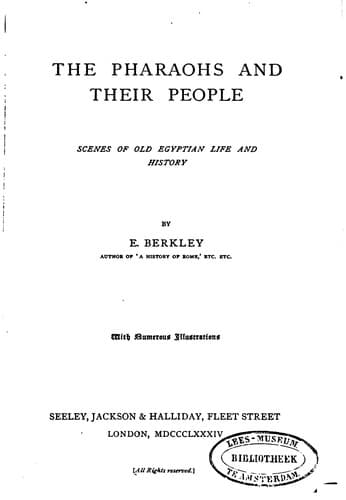
The Pharaohs and Their People: Scenes of old Egyptian life and historyBerkley, E.
History
The Pharaohs and Their People: Scenes of old Egyptian life and history
Berkley, E.
Egypt -- History -- To 332 B.C.
I took by storm, putting to death both small and great.’ Soon after
this the gallant Tirhakah died, after a reign of twenty-six years, and
his successor, Urdamaneh, following in his steps, occupied Thebes, and
once more attempted to wrest Egypt from the invader. Assur-bani-pal
took the field in person, and again compelled his foe to retire to the
far south. On Thebes he took dire vengeance. ‘My warriors attacked the
city, and razed it to the ground like a thunderbolt.’ Thebes certainly
was not ‘razed to the ground,’ as the proud conqueror boasts, but
the destruction was terrible, and the city never recovered the blow.
‘Gold and silver, the treasures of the land, precious stones, horses,
men and women, huge apes from the mountains—my soldiers took out
of the midst of the city as spoil. They brought it to Nineveh, the
city of my dominion, and they kissed my feet.’ Not far from Nineveh
there was living at this time an exile from Israel, who may himself
have seen the Egyptian prisoners and the spoil of Thebes. In his
indignant denunciation of Nineveh and her king, he thus addresses the
magnificent and cruel city: ‘Art thou better than No-Amon “(the city of
Amen = Thebes),” that was enthroned among the streams, and the floods
were round about her; her rampart was upon the river, and the waters
her defence. Ethiopia and Egypt were her strength, and it was infinite;
Put and Lubim were her helpers. Yet was she carried away and went into
captivity; her young children were dashed in pieces at the top of all
the streets: they cast lots for her honourable men, and her great men
were bound with chains’ (Nahum iii. 8-10).[90]
It was little more than half a century later that Nineveh herself fell
with a mightier and more overwhelming destruction.
FOOTNOTES:
[79] The Egyptian Pa-Bast, or the city of Bast. It was situated in the
eastern portion of the Delta, and was of immemorial antiquity. Under
the kings of the twenty-second dynasty, it attained great splendour,
and the worship of Bast became wide-spread and popular. Herodotus saw
her magnificent temple, and the festival celebrated in her honour with
such splendour and revelry. Bast was almost identical with Sechet—the
lioness and the cat were sacred to her. Her worship was exceedingly
popular under the later dynasties, and this led to the wide-spread
reverence with which the cat was regarded in those days.
[80] Probably a princess of the dynasty ruling at Tanis; the
priest-kings, whose seat of power was in the far south, are less likely
to have connected themselves with the kingdom of Israel.
[81] The Apis must be black, with certain white marks of mystical
import.
[82] One mode of consulting the sacred bull was by offering him food.
Germanicus is said to have thus consulted him; the Apis refused to eat,
and this unfavourable reception was considered to have foreboded his
untimely fate.
[83] The country known as Nubia then formed part of the land of Kush,
_i.e._ Ethiopia.
Public-domain text, read in full here on John Shaqi.
Reviews
Reviews
No reviews yet
Be the first to share your thoughts on this work.
Elsewhere in the archive
Join the Discussion
Join the discussion
Sign in to leave a comment or review.
Sign InorCreate an account