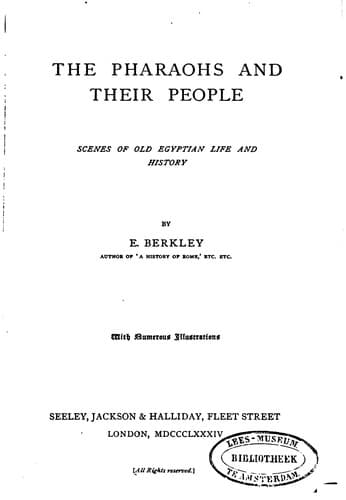
The Pharaohs and Their People: Scenes of old Egyptian life and historyBerkley, E.
History
The Pharaohs and Their People: Scenes of old Egyptian life and history
Berkley, E.
Egypt -- History -- To 332 B.C.
Babylon, Elam, and Arabia, leagued against Assyria about 650 B.C.,
had been successively defeated by King Assur-bani-pal, who took
Babylon itself 648 B.C. A pause ensued, for it was no light task to
encounter the Assyrian even in the hour of his decline; but on the
death of Assur-bani-pal there appears to have been a revolt of some
kind, and Nabopolassar, a general who succeeded in putting it down,
was made ruler of Babylon by the king of Nineveh. But the ambitious
Nabopolassar formed an alliance with the king of Media, and their
combined attack was the death-blow of the Assyrian monarchy. It was,
perhaps, through a common understanding with the allied states that
Psammetichus had besieged Azotus, which lay on the old military road
by the sea-coast. Necho took a more active part, and led his army as
far as the Euphrates. Whilst on the march, Josiah, king of Judah, had
rashly come out to offer him battle, and had been defeated and slain
at Megiddo. It must have been at this crisis that Nineveh fell; but
though her fall must have shaken the earth no record has come to us
concerning it—its precise date is unknown. Only in the exultant cry of
a Hebrew prophet[94] do we hear any echo of the shout of execration and
the outburst of triumph that went up as the great city fell:—
‘Nineveh is laid waste! who will bemoan her? Whence
shall I seek for comforters for thee?... There is no
healing of thy hurt; thy wound is incurable: all that
hear of thee shall clap their hands over thee: for upon
whom hath not thy wickedness passed continually?’
Public-domain text, read in full here on John Shaqi.
Reviews
Reviews
No reviews yet
Be the first to share your thoughts on this work.
Elsewhere in the archive
Join the Discussion
Join the discussion
Sign in to leave a comment or review.
Sign InorCreate an account