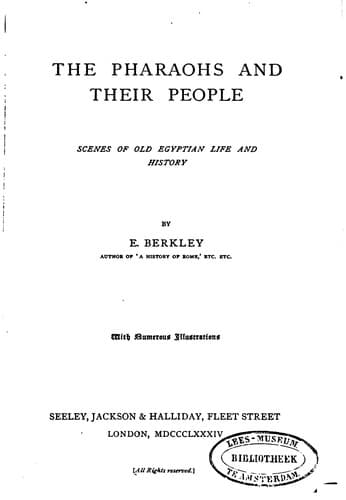
The Pharaohs and Their People: Scenes of old Egyptian life and historyBerkley, E.
History
The Pharaohs and Their People: Scenes of old Egyptian life and history
Berkley, E.
Egypt -- History -- To 332 B.C.
[93] Sais, in the Delta, was a magnificent city, and the temple of
the goddess Neith, who was worshipped there, was celebrated for its
splendour. The worship of Neith goes back to the earliest times, but
under the dynasty which had its seat at Sais it attained very great
prominence. Neith was a nature-goddess, and was called the ‘mother
of the sun.’ She represents the hidden and mysterious ground of all
things, and hence was naturally regarded as the goddess of wisdom.
Like Athena, to whom the Greeks compared her, she was at the same time
goddess of war. Over her temple was the inscription: ‘I am what is,
what shall be, and what has been, and no man hath lifted my veil; I am
the great mother of Ra.’
[94] Nahum iii. 7, 19; ‘No spark of pity mingles with the prophet’s
delight.’—Stanley, _Jewish Church_.
[95] Jer. xlvi. 8, 9.
[96] Jer. xlvi. 5, 16.
[97] 2 Kings xxiv. 7.
[98] It was natural not to send Greeks against their fellow-countrymen,
though the action was otherwise interpreted.
[99] The story of Herodotus is that an Egyptian oculist had been sent
to Persia to cure the king, who was suffering from some complaint of
the eyes. Cambyses heard so much from him of the beauty of the daughter
of Amasis, that he desired to have her for his wife. Amasis, unwilling
to send his own daughter, substituted the daughter of his predecessor
Apries. Cambyses, on discovering the fraud, was so enraged that he
undertook the invasion of Egypt to punish the perfidy of its king.
Cambyses certainly was not the man to wait for a pretext, whether the
story be true or not. The narratives of Herodotus are by no means to be
relied on; all that he relates as an eye-witness is of the utmost value.
[100] Brugsch, _History of Egypt_.
[101] It was Uah-hor-penres, priest of Neith, of whom Cambyses
inquired, and who seems to have won great respect from the king. Sais
appears, through his influence and good offices, to have been ‘saved in
the great calamity that fell upon the land.’
[102] Lord Derby’s translation.
[103] ‘All intellectual Greeks,’ says Grote, ‘were naturally attracted
to go and visit the wonders on the banks of the Nile.’
[104] Grote.
APPENDIX I.
TABLE OF DYNASTIES.
DYNASTY I.—THINITE.
Mena. Hesepti.
Teta. Merbap.
Atet. Sememptah.
Ata. Kebeh.
DYNASTY II.—THINITE.
Betau. Uatnes.
Kakau. Senta.
Bai-en-neter.
DYNASTY III.—MEMPHITE.
Tati. Teta I.
Bebi. Setes.
Nebka. Neferkara.
Sersa. Senefru.
DYNASTY IV.—MEMPHITE.
Khufu. Menkaura.
Tetefra. Aseskaf.
Khafra.
DYNASTY V.—MEMPHITE.
Userkaf. Userenra.
Sehura. Menkauhor.
Kaka. Tetkara.
Neferarkara. Unas.
Public-domain text, read in full here on John Shaqi.
Reviews
Reviews
No reviews yet
Be the first to share your thoughts on this work.
Elsewhere in the archive
Join the Discussion
Join the discussion
Sign in to leave a comment or review.
Sign InorCreate an account