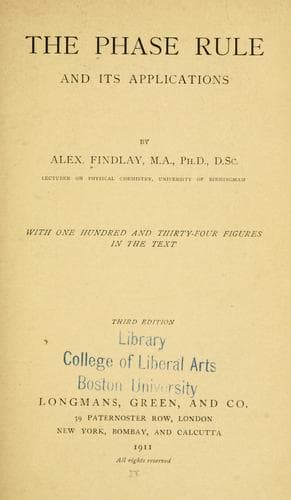
The Phase Rule and Its ApplicationsFindlay, Alexander
Science
The Phase Rule and Its Applications
Findlay, Alexander
Chemistry, Physical and theoretical; Phase rule and equilibrium; Solution (Chemistry)
4NaKC_{4}O_{6}H_{4},4H_{2}O = 2Na_{2}C_{4}O_{6}H_{4},2H_{2}O
+ 2K_{2}C_{4}O_{6}H_{4},½H_{2}O + 11H_{2}O
On the other hand, if sodium and potassium tartrates are mixed with water
in the proportions shown on the right side of the equation, the system will
remain partially liquid so long as the temperature is maintained above 55°
(in a closed vessel to prevent loss of water), but on allowing the
temperature to fall below this point, complete solidification will ensue,
owing to the formation of the hydrated double salt. Below 55°, therefore,
the hydrated double salt is the stable system, while above this temperature
the two single salts plus saturated solution are stable.[337]
A similar behaviour is found in the case of the double salt copper
dipotassium chloride (CuCl_{2},2KCl,2H_{2}O or CuK_{2}Cl_{4},2H_{2}O).[338]
When this salt is heated to 92°, partial liquefaction occurs, and the
original blue plate-shaped crystals give place to brown crystalline needles
and white cubes; while on allowing the temperature to fall, re-formation of
the blue double salt ensues. The temperature 92° is, therefore, a
transition point at which the reversible reaction--
CuK_{2}Cl_{4},2H_{2}O <--> CuKCl_{3} + KCl + 2H_{2}O
takes place.
The decomposition of sodium potassium tartrate, or of copper dipotassium
chloride, differs in so far from that of Glauber's salt that _two_ new
solid phases are formed; and in the case of copper dipotassium chloride,
one of the decomposition products is itself a double salt.
In the two examples of double salt decomposition which have just been
mentioned, sufficient water was yielded to cause a partial liquefaction;
but other cases are known where this is not so. Thus, when copper calcium
acetate is heated to a {260} temperature of 75°, although decomposition of
the double salt into the two single salts occurs as represented by the
equation[339]--
CuCa(C_{2}H_{3}O_{2})_{4},8H_{2}O = Cu(C_{2}H_{3}O_{2})_{2},H_{2}O
+ Ca(C_{2}H_{3}O_{2})_{2},H_{2}O
+ 6H_{2}O
the amount of water split off is insufficient to give the appearance of
partial fusion, and, therefore, only a change in the crystals is observed.
Public-domain text, read in full here on John Shaqi.
Reviews
Reviews
No reviews yet
Be the first to share your thoughts on this work.
Elsewhere in the archive
Join the Discussion
Join the discussion
Sign in to leave a comment or review.
Sign InorCreate an account