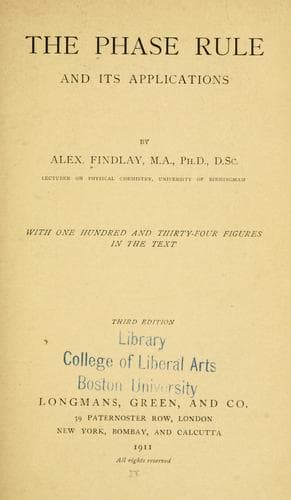
The Phase Rule and Its ApplicationsFindlay, Alexander
Science
The Phase Rule and Its Applications
Findlay, Alexander
Chemistry, Physical and theoretical; Phase rule and equilibrium; Solution (Chemistry)
W
Water, 21
----, acetic acid, chloroform, 241
----, acetone, phenol, 248
----, alcohol, ether, 246
----, ----, chloroform, 246
----, aniline, phenol, 250
----, bivariant systems of, 29
----, critical pressure of, 23
----, critical temperature of, 23
----, equilibrium between ice and, 25
----, ---- between vapour and, 21
----, ether, succinic nitrile, 252
----, supercooled, 30
----, ----, vapour pressure of, 31
----, vaporization curve of, 21
----, vapour pressure of, 23
Z
Zeolites, 176
Zinc, lead, silver, 246
---- chloride in water, solubility of, 157
THE END
PRINTED BY WILLIAM CLOWES AND SONS, LIMITED, LONDON AND BECCLES.
* * * * *
NOTES
[1] Except when the volume of the liquid becomes exceedingly small, in
which case the surface tension exerts an influence on the vapour pressure.
[2] For reasons which will appear later (Chap. IV.), the volume of the
vapour is supposed to be large in comparison with that of the solid and
liquid.
[3] Ramsay and Young, _Phil. Trans._, 1886, 177. 87.
[4] See, more especially, Vogt, _Die Silikatschmelzlösungen_. (Christiania,
1903, 1904.)
[5] _Trans. Connecticut Acad._, 1874-1878.
[6] Lehre von der chemischen Verwandtschaft der Körper, 1777.
[7] See Ostwald's _Klassiker_, No. 74.
[8] Etudes sur les affinités chimiques, 1867; Ostwald's _Klassiker_, No.
104.
[9] Died April, 1903.
[10] For a mathematical treatment of the Phase Rule the reader is referred
to the volume in this series on Thermodynamics, by F. G. Donnan.
[11] Liebig's _Annalen_, 1873, 170, 192; Ostwald, _Lehrbuch_, II. 2. 111.
[12] The action of gravity and other forces being excluded (see p. 5).
[13] It may seem as if this were a contradiction to what was said on p. 4
as to the effect of the addition of ammonia or hydrogen chloride to the
system constituted by solid ammonium chloride in contact with its products
of dissociation. There is, however, no contradiction, because in the case
of ammonium chloride the gaseous phase consists of ammonia and hydrogen
chloride in equal proportions, and in adding ammonia or hydrogen chloride
alone we are not adding the gaseous phase, but only a constituent of it.
Addition of ammonia and hydrogen chloride together in the proportions in
which they are combined to form ammonium chloride would cause no change in
the equilibrium.
[14] The vapour pressure of water in small drops is greater than that of
water in mass, and the solubility of a solid is greater when in a state of
fine subdivision than when in large pieces (_cf._ Hulett, _Zeitschr.
physikal. Chem._, 1901, 37. 385).
[15] See Ostwald, _Lehrbuch_, II. 2. 476, 934; Roozeboom, _Zeitschr.
physikal. Chem._, 1894, 15. 150; _Heterogene Gleichgewichte_, I. p. 16;
Wegscheider, _Zeitschr. physikal. Chem._, 1903, 43. 89.
[16] Ostwald, _Lehrbuch_, II. 2. 478.
[17] See also Hoitsema, _Zeitschr. physikal. Chem._ 1895, 17. 651.
Public-domain text, read in full here on John Shaqi.
Reviews
Reviews
No reviews yet
Be the first to share your thoughts on this work.
Elsewhere in the archive
Join the Discussion
Join the discussion
Sign in to leave a comment or review.
Sign InorCreate an account