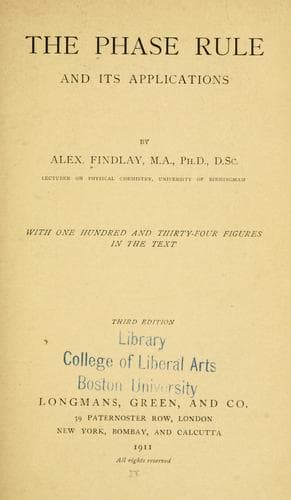
The Phase Rule and Its ApplicationsFindlay, Alexander
Science
The Phase Rule and Its Applications
Findlay, Alexander
Chemistry, Physical and theoretical; Phase rule and equilibrium; Solution (Chemistry)
From this definition we see that the term solution is not restricted to any
particular physical state of substances, but includes within its range not
only the liquid, but also the gaseous and solid states. We may therefore
have solutions of gases in liquids, and of gases in solids; of liquids in
liquids or in solids; of solids in liquids, or of solids in solids.
Solutions of gases in gases are, of course, also possible; since, however,
gas solutions never give rise to more than one phase, their {93} treatment
does not come within the scope of the Phase Rule, which deals with
heterogeneous equilibria.
It should also be emphasized that the definition of solution given above,
neither creates nor recognizes any distinction between solvent and
dissolved substance (solute); and, indeed, a too persistent use of these
terms and the attempt to permanently label the one or other of two
components as the solvent or the solute, can only obscure the true
relationships and aggravate the difficulty of their interpretation. In all
cases it should be remembered that we are dealing with equilibria between
two components (we confine our attention in the first instance to such),
the solution being constituted of these components in variable and varying
amounts. The change from the case where the one component is in great
excess (ordinarily called the solvent) to that in which the other component
predominates, may be quite gradual, so that it is difficult or impossible
to say at what point the one component ceases to be the solvent and becomes
the solute. The adoption of this standpoint need not, however, preclude one
from employing the conventional terms solvent and solute in ordinary
language, especially when reference is made only to some particular
condition of equilibrium of the system, when the concentration of the two
components in the solution is widely different.
SOLUTIONS OF GASES IN LIQUIDS.
As the first class of solutions to which we shall turn our attention, there
may be chosen the solutions of gases in liquids, or the equilibria between
a liquid and a gas. These equilibria really constitute a part of the
equilibria to be studied more fully in Chapter VIII.; but since the
two-phase systems formed by the solutions of gases in liquids are among the
best-known of the two-component systems, a short section may be here
allotted to their treatment.
Public-domain text, read in full here on John Shaqi.
Reviews
Reviews
No reviews yet
Be the first to share your thoughts on this work.
Elsewhere in the archive
Join the Discussion
Join the discussion
Sign in to leave a comment or review.
Sign InorCreate an account