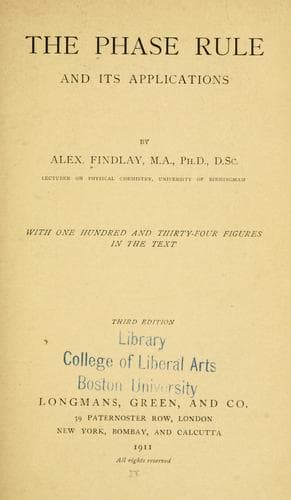
The Phase Rule and Its ApplicationsFindlay, Alexander
Science
The Phase Rule and Its Applications
Findlay, Alexander
Chemistry, Physical and theoretical; Phase rule and equilibrium; Solution (Chemistry)
When a gas is passed into a liquid, absorption takes place to a greater or
less extent, and a point is at length reached when the liquid absorbs no
more of the gas; a condition of equilibrium is attained, and the liquid is
said to be saturated {94} with the gas. In the light of the Phase Rule,
now, such a system is bivariant (two components in two phases); and two of
the variable factors, pressure, temperature, and concentration of the
components, must therefore be chosen in order that the condition of the
system may be defined. If the concentration and the temperature are fixed,
then the pressure is also defined; or under given conditions of temperature
and pressure, the concentration of the gas in the solution must have a
definite value. If, however, the temperature alone is fixed, the
concentration and the pressure can alter; a fact so well known that it does
not require to be further insisted on.
As to the way in which the solubility of a gas in a liquid varies with the
pressure, the Phase Rule of course does not state; but guidance on this
point is again yielded by the theorem of van't Hoff and Le Chatelier. Since
the absorption of a gas is in all cases accompanied by a diminution of the
total volume, this process must take place with increase of pressure. This,
indeed, is stated in a quantitative manner in the law of Henry, according
to which the amount of a gas absorbed is proportional to the pressure. But
this law must be modified in the case of gases which are very readily
absorbed; the _direction of change_ of concentration with the pressure
will, however, still be in accordance with the theorem of Le Chatelier.
If, on the other hand, the pressure is fixed, then the concentration will
vary with the temperature; and since the absorption of gases is in all
cases accompanied by the evolution of heat, the solubility is found, in
accordance with the theorem of Le Chatelier, to diminish with rise of
temperature.
In considering the changes of pressure accompanying changes of
concentration and temperature, a distinction must be drawn between the
total pressure and the partial pressure of the dissolved gas, in cases
where the solvent is volatile. In these cases, the law of Henry applies not
to the total pressure of the vapour, but only to the partial pressure of
the dissolved gas. {95}
SOLUTIONS OF LIQUIDS IN LIQUIDS.
Public-domain text, read in full here on John Shaqi.
Reviews
Reviews
No reviews yet
Be the first to share your thoughts on this work.
Elsewhere in the archive
Join the Discussion
Join the discussion
Sign in to leave a comment or review.
Sign InorCreate an account