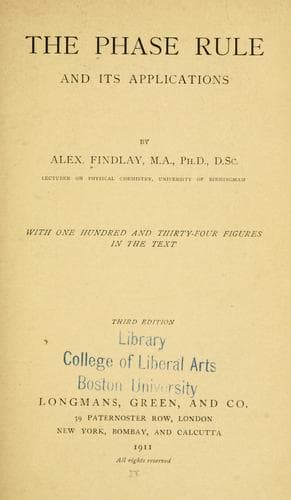
The Phase Rule and Its ApplicationsFindlay, Alexander
Science
The Phase Rule and Its Applications
Findlay, Alexander
Chemistry, Physical and theoretical; Phase rule and equilibrium; Solution (Chemistry)
Complete Miscibility.--Although the phenomena of complete miscibility are
here treated under a separate heading, it must not be thought that there is
any essential difference between those cases where the liquids exhibit
limited miscibility and those in which only one homogeneous solution is
formed. As has been already pointed out, the solubility relations alter
with the temperature; and liquids which at one temperature can dissolve in
one another only to a limited extent, are found at some other temperature
to possess the property of complete miscibility. Conversely, we may expect
that liquids which at one temperature, say at the ordinary temperature, are
miscible in all proportions, will be found at some other temperature to be
only partially miscible. Thus, for example, it was found by Guthrie that
ethyl alcohol and carbon disulphide, which are miscible in all proportions
at the ordinary temperature, possess only limited miscibility at
temperatures below -14.4°.[178] Nevertheless, it is doubtful if the
critical solution temperature is in all cases experimentally realizable.
Pressure-Concentration Diagram.--Since, in the cases of complete
miscibility of two liquid components, there are never more than two phases
present, the system must always be bivariant; and two of the variables
pressure, temperature or concentration of the components, must be
arbitrarily chosen {105} before the system becomes defined. For this reason
the Phase Rule affords only a slight guidance in the study of such
equilibria; and we shall therefore not enter in detail into the behaviour
of these homogeneous mixtures. All that the Phase Rule can tell us in
connection with these solutions, is that at constant temperature the vapour
pressure of the solution varies with the composition of the liquid phase;
and if the composition of the liquid phase remains unchanged, the pressure
also must remain unchanged. This constancy of composition is exhibited not
only by pure liquids, but also by liquid solutions in all cases where the
vapour pressure of the solution reaches a maximum or minimum value. This is
the case, for example, with mixtures of constant boiling point.[179]
* * * * *
{106}
CHAPTER VII
SOLUTIONS OF SOLIDS IN LIQUIDS, ONLY ONE OF THE COMPONENTS BEING VOLATILE
Public-domain text, read in full here on John Shaqi.
Reviews
Reviews
No reviews yet
Be the first to share your thoughts on this work.
Elsewhere in the archive
Join the Discussion
Join the discussion
Sign in to leave a comment or review.
Sign InorCreate an account