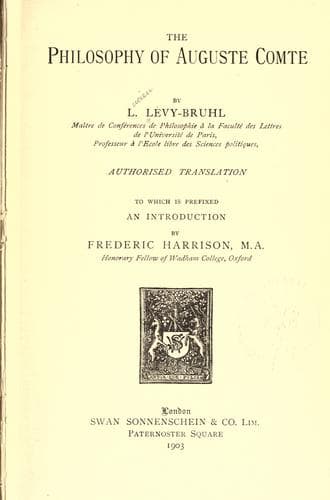
Being founded upon positive science, Comte’s ethics will reproduce its
essential characteristics. In the first place it will be “real,” that
is to say it will rest upon observation and not upon imagination. It
will consider man as he is and not as he fancies himself to be. It will
then rest, not upon the abstract analysis which he may make of his own
heart, but upon the proofs given by humanity of its inclinations and
of the usual motives for its actions, during the centuries made known
to us by history. In a word, through the use of an objective and truly
scientific method, it will avoid serious causes for mistakes.
Being positive, this morality will be relative. For the immediate and
necessary consequence of the relativity of knowledge is the relativity
of morality. Kant, whom Comte himself called “the last of his great
precursors,” attempted to preserve an absolute character for ethics: it
is because, at bottom, he also preserved metaphysics. The moral law,
says Kant, is universally valid for every free and reasonable being.
But the only species of beings of this kind which we know, the human
species, is developed in time according to the laws of a necessary
progress. At every stage in this development it was not possessed of
an equal aptitude for understanding a moral law. The most we can say
is that, with time, the aptitude becomes greater and greater. Then,
the existence of our species depends upon a great number of natural
conditions--astronomical, physical, biological, sociological. If these
conditions were different, which is not an absurd hypothesis, our
morality would be different also. It is then relative at once to our
situation and to our organisation.”
The idea of a relative morality is still a source of anxiety to many
minds, who take it to be a preliminary step towards the negation of all
morality. They think that, either good is absolute or the distinction
between good and evil vanishes; there is no middle course. However,
history shows that there is a way out of such deadlocks. Was not a
similar dilemma put on the subject of knowledge? Was it not even said:
either truth is absolute, or there is not truth at all? The dilemma was
a false one. The human mind has become accustomed to relative truths;
and an analogous solution will end by being also accepted for ethics.
The acknowledgment of its relativity will not be any more fatal for it
than it has been for science.
Public-domain text, read in full here on John Shaqi.
Reviews
Reviews
No reviews yet
Be the first to share your thoughts on this work.
Elsewhere in the archive
Join the Discussion
Join the discussion
Sign in to leave a comment or review.
Sign InorCreate an account