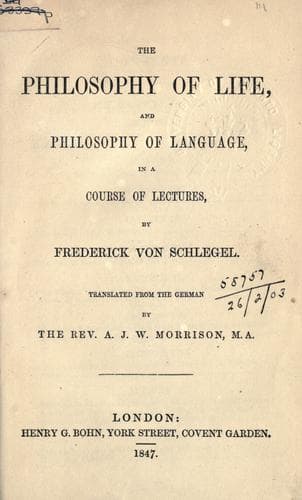
The philosophy of life, and philosophy of language, in a course of lecturesSchlegel, Friedrich von
Philosophy
The philosophy of life, and philosophy of language, in a course of lectures
Schlegel, Friedrich von
Language and languages -- Philosophy; Life; Philosophy
It is, we remarked, the problem of philosophy, leaving to physics the
whole development of life that lies intermediate between the beginning
and end, to explain the two extremes of nature. As, therefore, we have
examined one of these extremes, and have discovered in the whole
terrestrial creation a Paradise as the blessed state of the still
innocent infancy of nature, before the revolt of the rebellious spirits
and the fall of the first man, the present seems the place for a few
words touching the opposite extreme--the regions of outer darkness. We
can safely admit that the figurative representations, not merely of
painters and poets, but occasionally also of the preacher, are so
horrible, and heaped together with so little consistency--the dark
colors laid on so thick, that the whole assumes to the feelings an
appearance of improbability, and, on this account, makes, for the most
part, no very deep impression. But the spiritual significance of these
sufferings, and the sort of propriety and design which holds, even in
this unnatural state, on the utmost borders of creation, may, perhaps,
be made clear by a very simple illustration. Most reluctantly, and with
a heavy heart assuredly, would an earthly parent resolve to turn out of
his house, and formally to disinherit, his first-born and beloved son,
even though he should have proved himself utterly worthless and
hopelessly depraved. But even if an earthly parent might be too hasty in
his anger, and actually be harsh and unjust, still we may boldly assume
that the love of our Heavenly Father, in patience and gentleness, far
transcends the truest parental love that is to be found on earth. But
when it actually comes to this point of offended mercy and justice, then
the disinherited, cast out into the regions of darkness, joins the band
of robbers who in the night lurk about his father’s house, seeking where
they may break into it. No other choice is left him than to become a
robber, and, whether he will or no, he must obey the leader of the band.
But better taught and as yet softer of heart than the rest, he must go
through many hardships and sufferings ere he becomes quite like the
others--as hard-hearted as the “murderers from the beginning,” who the
while look down upon him with scorn and contempt.
Public-domain text, read in full here on John Shaqi.
Reviews
Reviews
No reviews yet
Be the first to share your thoughts on this work.
Elsewhere in the archive
Join the Discussion
Join the discussion
Sign in to leave a comment or review.
Sign InorCreate an account