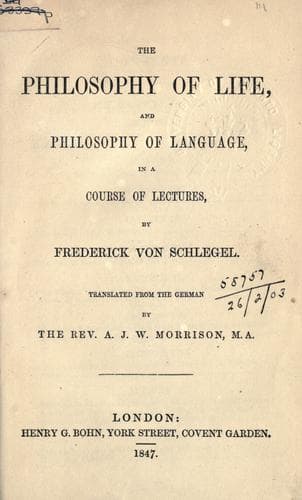
The philosophy of life, and philosophy of language, in a course of lecturesSchlegel, Friedrich von
Philosophy
The philosophy of life, and philosophy of language, in a course of lectures
Schlegel, Friedrich von
Language and languages -- Philosophy; Life; Philosophy
God is a spirit of truth; and in the realm of truth, therefore, the
divine order, and the law of wisdom which reigns therein, shines forth
with an especial clearness--with a higher degree of evidence or greater
perspicuity than even in the region of nature, which for us is for the
most part half-dark, or at the very best but a _chiaro-oscuro_--a
mixture of light and darkness. But man, formed out of the dust of the
earth, placed, as it were, in the very center of nature, as its
first-born son or its earthly lord, is in this respect himself a natural
being. Even in his susceptibility for higher and divine truth, man is
tied to and is dependent on a similar and collateral grade of
development in the life of nature, which can in no case be violently
broken, nor a step in it arbitrarily overleaped, without involving the
most disastrous consequences as the penalty of so unnatural a course.
Even in education there reigns a similar law of gradual development
according to the natural progression of the different ages of life. With
the boy of good and natural abilities, who shows an aptness and
willingness to learn when knowledge is presented to his mind, and
implanted in a true and living form, the teacher’s first care is to
improve this disposition, and to strengthen and to foster it, and, by
furnishing it with the due measure and the right quality of intellectual
culture, gradually to develop its powers. At this age the moral part of
education will wisely confine itself to laying a foundation of good
habits, to the careful exclusion of all evil communication and the
deadly contagion of wicked example. In the soft and yielding character
of the child there can scarcely be as yet any question about principles
or sentiments. But the case is very different with youth. If at this
time of life the moral character be not carefully formed simultaneously
with its scientific cultivation, then is the good season irreparably
lost, and rarely, if ever, can the deficiency be afterward supplied. For
when this stage of intellectual and moral culture is once passed, when
the mind has begun at last to move with greater freedom and to mature
itself, the young man is at once admitted to the full light of science,
or enters into the busy course of active life, to be there brought to
the touchstone of experience.
Public-domain text, read in full here on John Shaqi.
Reviews
Reviews
No reviews yet
Be the first to share your thoughts on this work.
Elsewhere in the archive
Join the Discussion
Join the discussion
Sign in to leave a comment or review.
Sign InorCreate an account