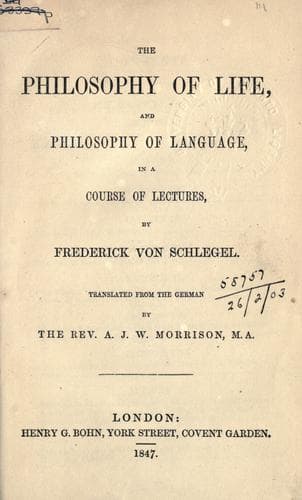
The philosophy of life, and philosophy of language, in a course of lecturesSchlegel, Friedrich von
Philosophy
The philosophy of life, and philosophy of language, in a course of lectures
Schlegel, Friedrich von
Language and languages -- Philosophy; Life; Philosophy
The second remark which we have to make before entering upon the
immediate subject of our Lecture refers to the natural progression of
the living development of the human consciousness. This gradation, we
would observe, holds good, and is applicable, not merely to the moral
education of man, but also to the intellectual improvement of man’s
capacity, as at present constituted, for all higher and divine verities.
But, however true this may be, where the general sense for truth is not
from the first open and full of light, where the soul is not already
perfectly free and pure; yet on the other hand there is nothing
against--on the contrary, every thing favors the supposition, that the
earliest revelation imparted to mankind--the illumination which was
given to the first man, and bestowed upon him as his heavenly
inheritance on earth, was a full and perfect enlightenment of his mind
[_geist_]. For his senses were open and clear, his soul as yet
incorrupt, pure, and free. Both were directed to God, and being one with
and at unison with nature, were keenly alive to and deeply impressed by
every token of God’s glory and majesty in creation. It is quite an error
to assume, or, rather, to fancy, that this state of purity and innocence
was a state of ignorance like that of the child or of the wild man. The
tree of life was given to him entirely and without reserve, as also
dominion over the earth, whose first-made living creatures the Lord
subjected to his dominion, bringing them before him to call and to name
them. The knowledge of death was indeed designedly withheld from him, as
also the existence of the evil spirits, even because it was exactly
therein that his trial and probation were to consist. And so both are
perfectly reconcilable: that height of knowledge in the clearest light
of nature, which the sacred traditions of all primitive nations so
positively and unanimously assign to the first man, is in nowise
inconsistent with that ignorance of death which is no less expressly
ascribed to him. Moreover, had man but preserved and kept alive in his
heart this feeling of God, he would immediately have recognized his
enemy, and even thereby have triumphed over him, and become the redeemer
of nature, instead of requiring, now that he has failed in that his high
destination, a Redeemer for his own fallen race. This first revelation,
therefore, was, we may well assume, in the beginning as it will also be
in the end, a full enlightenment of the spirit of man, but which,
however, was soon darkened by his disobedience and fall. This, too, is
the shape which the matter assumes in the legendary history of all the
primeval nations of antiquity, and these are the threads of light which
in the labyrinthine confusion of legends, symbols, and tongues of
earliest heathendom, carry us safely out of its mazes and back to the
clear starting-point of the pure and undefiled revelation of God. It
were not difficult to show how, through the first two millenniums and a
Public-domain text, read in full here on John Shaqi.
Reviews
Reviews
No reviews yet
Be the first to share your thoughts on this work.
Elsewhere in the archive
Join the Discussion
Join the discussion
Sign in to leave a comment or review.
Sign InorCreate an account