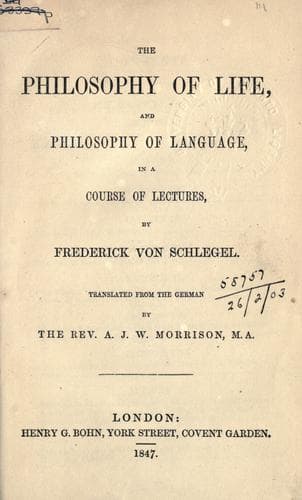
The philosophy of life, and philosophy of language, in a course of lecturesSchlegel, Friedrich von
Philosophy
The philosophy of life, and philosophy of language, in a course of lectures
Schlegel, Friedrich von
Language and languages -- Philosophy; Life; Philosophy
Waiting, therefore, for this manifestation, we must endure with the more
patience the existing discord so long as our lot is placed amid it, and
show greater moderation toward it, since we are subject to it in hope.
Only let me not be thought of as recommending a spurious impartiality,
which, in truth, is little better than a culpable indifference to
questions the most important that can agitate our own generation and all
humanity--or the indiscriminating contempt of an arrogated superiority,
which is even still more offensive and baneful to truth than the most
vehement adoption of either of the conflicting views, if associated with
honesty of purpose and conviction. As little, too, would I be thought to
favor the presumptuous decisions of individuals, which, adopting a
peculiar principle, or, as it is styled, a higher point of view, even
though occasionally it does justice to each in part, yet on the whole
materially wrongs them both. In the first ages of this intellectual
disease, great names were arrayed on either side; and that through all
its variations brilliant talents and scientific attainments maintained
the conflict, while there was much that was false and wrong in both
parties, is equally unquestionable. But what avails the unrighteousness
of man against the righteousness of the cause, when, as we must, we
regard the latter as the cause of God?
The painful feature of the conflict is the fact that, in a certain
measure, God Himself has become the object of man’s rancor and
animosity. In sacred lore and tradition, but pre-eminently in
revelation, God Himself became as it were a child; and in the childlike
language of the heart, and in the most confiding manner, gave Himself
into the hands of men. But now, even this marvelous child and the divine
word is near being torn asunder by the disputants, like the child in the
old story or parable. Two mothers, we are told, came and stood before
the king, disputing violently whose was the child that had been
overlaid, and whose was the living one. But the true mother, for both
had fallen asleep in the night, was recognized by her prayer that the
child might not be divided in two by the sword of justice, but preferred
that her son should live, even though she must lose it by resigning it
to the other. Whereupon the king ordered his officers in no wise to slay
the living child, but to give it to her who by her love had proved
herself its mother.[43]
Public-domain text, read in full here on John Shaqi.
Reviews
Reviews
No reviews yet
Be the first to share your thoughts on this work.
Elsewhere in the archive
Join the Discussion
Join the discussion
Sign in to leave a comment or review.
Sign InorCreate an account