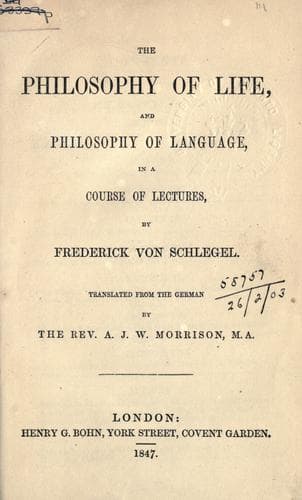
The philosophy of life, and philosophy of language, in a course of lecturesSchlegel, Friedrich von
Philosophy
The philosophy of life, and philosophy of language, in a course of lectures
Schlegel, Friedrich von
Language and languages -- Philosophy; Life; Philosophy
The human race, then, as it had a beginning, so also will it have an
end; it will not continue forever in this present form, but must
eventually come to a termination. But, to speak according to the measure
of a divine chronology, where a thousand years are but as one day, who
can say, who shall dare, off-hand, to decide whether six or seven of
these great days of God are fixed for its duration? Enough to know that
we stand on the borders of the fourth age, and on the passage from the
third to the fourth. And not unimportant is it, on the other hand, for
the clear understanding of the whole, to form a right conception of each
of these, its great divisions and epochs. The first age is made up of
the twenty-five centuries of obscure primeval history. The second, which
we called the age of preparation, is formed by the fifteen hundred years
which we reckon from the end of the first up to the center and
turning-point of the history of the world as known to us, and from which
modern history takes its commencement. Even in the oldest traditionary
history of the Gentile nations of antiquity we do not meet with any
statements that can be relied upon, or any tenable data beyond, if
indeed so far back as, the fifteenth century before the epoch of the
commencement of modern history. The fifteen centuries which follow this
epoch form the third age, in which this principle of a new life in the
spiritual, moral, and political world had to develop and completely to
unfold itself. In the last Lecture I also reckoned in this period the
sixteenth, seventeenth, and eighteenth centuries of our era. But if it
seems to any more advisable to consider these as the introductory
portion of the fourth and subsisting age, there is nothing positively to
condemn such a mode of reckoning; only, for my part, I can not but
regard it as less correct and more inaccurate than the one which I have
proposed. In one case as well as the other the same important
consideration will be involved. Reckoning from some point or other
within these last forty years, we have, it must be acknowledged by all,
entered upon a grand and decisive epoch in the history of the world; and
our attention can not be too often or too strongly directed to the fact,
that we stand at the critical point of transition from one great period
to another.
Public-domain text, read in full here on John Shaqi.
Reviews
Reviews
No reviews yet
Be the first to share your thoughts on this work.
Elsewhere in the archive
Join the Discussion
Join the discussion
Sign in to leave a comment or review.
Sign InorCreate an account