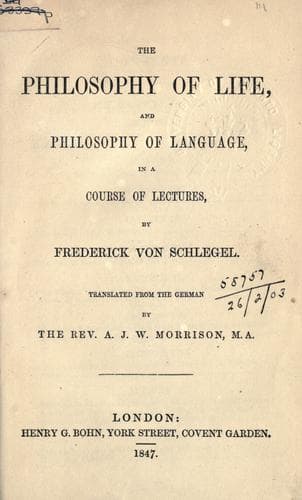
The philosophy of life, and philosophy of language, in a course of lecturesSchlegel, Friedrich von
Philosophy
The philosophy of life, and philosophy of language, in a course of lectures
Schlegel, Friedrich von
Language and languages -- Philosophy; Life; Philosophy
Do we further ask in what, if in any respect, the earthly sovereign is
the deputy of God, as Redeemer, Emancipator, and Liberator? A notion of
grace and mercy does, we must admit, attach itself to our idea of
supreme authority; and in this respect it presents a sort of analogy and
resemblance to the idea of the Godhead. Properly speaking, however, the
exercise of grace and mercy forms an exception to the general rule of
man’s sovereignty, and belongs to him only in his special function as
administrator of justice. Moreover, the most paternal and beneficent of
earthly rulers can at most provide only for the physical happiness of
his people. He may alleviate or avert heavy calamities, or procure many
temporal blessings and advantages for his subjects; but the unhappy soul
can be helped by One alone. The distinction I have just made will become
more apparent by means of a contrast. Wherever the clergy are not
regarded merely as teachers of the people, but as is the case in the
greater part of Western and of Eastern Christendom, as priests speaking
with a divine authority, this their public vicegerency relates primarily
and immediately to the _Redeemer_; its judicial functions over the
conscience ought to shun a visible publicity, and to be left entirely to
the conscience and guarded by its seal of secrecy. And in this respect
lies the distinctive peculiarity of the relation subsisting between the
supreme authority in the state and God, which, however, refers
pre-eminently to His attribute of _justice_. And here it is no mere
remote analogy and weak resemblance, dependent on the principle of human
weakness and imperfection; but it is a true and real vicegerency,
publicly admitted and recognized, and exercising consequently a great
public influence. And therefore it is, that among the divers elements or
branches of the supreme political authority (which, however,
fundamentally and in its essence is one and indivisible), a special
sanctity is, as I have already remarked, ascribed to its judicial
functions. In a word, the earthly head of the state is the dispenser of
the divine justice, the vicegerent of the Judge of the world; he is a
divine functionary, and, so to say, the supreme judge in the world’s
tribunal. And this is the point of view from which all matters and
questions connected with this subject may most fully be answered and
most correctly determined. But that this exalted dignity of the earthly
ruler may not be interpreted too literally, I must here observe, that
the divine Judge is one who allows mercy to take the place of justice,
not merely occasionally, and by way of exception, but always and
invariably; so long, at least, as it is in any way possible. And here
comes in the application of the principle which we previously
advanced:--That God is in nowise absolute, but that on the contrary His
justice is in every case limited by His love and grace; while the latter
again is restricted and modified by His justice, and both, indeed,
Public-domain text, read in full here on John Shaqi.
Reviews
Reviews
No reviews yet
Be the first to share your thoughts on this work.
Elsewhere in the archive
Join the Discussion
Join the discussion
Sign in to leave a comment or review.
Sign InorCreate an account