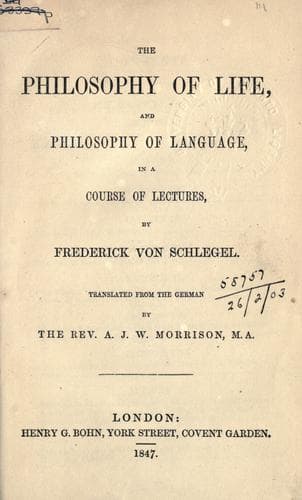
The philosophy of life, and philosophy of language, in a course of lecturesSchlegel, Friedrich von
Philosophy
The philosophy of life, and philosophy of language, in a course of lectures
Schlegel, Friedrich von
Language and languages -- Philosophy; Life; Philosophy
Absolute, if this pernicious term must be used, the supreme power of the
legitimate sovereign of a state may indeed be called in so far as he is
responsible to God alone. For were the supreme ruler responsible to man,
then the only difference would be, that instead of one, the many to whom
he is answerable would be absolute. But in another sense, it is
impossible to call the supreme power, wherever lodged, absolute or
unlimited; for it is limited in many ways. Its exercise is checked and
controlled by the treaties subsisting between it and other powers--by
the laws which it finds in existence from the times of his predecessors,
and which are still in force by the family laws of succession, and all
matters pertaining to or connected therewith. If he who is invested with
the highest power in the state, is determined to interfere with all
these institutions, and violently to subvert existing customs and
compacts, then is there, in such a case, no one really justified or
entitled either to make objections to his measures or to oppose them. By
such arbitrary and violent proceedings, however, he is himself
undermining the very foundation of his own power. And a regard to and
consideration of the possible consequences of such injustice will in
most instances furnish the necessary and salutary check. Lastly, if we
look a moment from the right itself to its actual exercise and
influence, how often and how greatly are the latter limited by adverse
circumstances and evil times. Nothing, in short, is more at issue with
and opposed to nature and to life, than the very notion of unlimited
power, and generally all that is absolute or destructive.
But there is yet another side on which the supreme political power is
essentially checked and controlled. It is bound to consider and pay
respect to the principles of religious society, which rests no less than
itself on a divine authority. For the church, although very different in
its nature, and flowing from a wholly different origin from that of the
state, is, nevertheless, equally inviolable. If, however, the civil and
political ruler, not content with a co-ordinate jurisdiction and the
revision of ecclesiastical affairs--with a joint authority and
influence, should attempt to make the religious polity also entirely
subject to his own arbitrary will, no one perhaps will be able to oppose
force to force, and probably no one would be justified in so doing. But
by such an attempt, as indeed by every act of religious oppression, the
supreme civil power would most fatally undermine the very basis of its
own authority. If, for instance, the ruler of a great nation places the
third estate in the painful alternative of making, what in any case must
be most pernicious, a choice between divine and human authority--or,
rather, to speak more correctly, between two claims to its allegiance
equally divine, he does but smooth the road which must lead at last to
his own ruin.
Public-domain text, read in full here on John Shaqi.
Reviews
Reviews
No reviews yet
Be the first to share your thoughts on this work.
Elsewhere in the archive
Join the Discussion
Join the discussion
Sign in to leave a comment or review.
Sign InorCreate an account