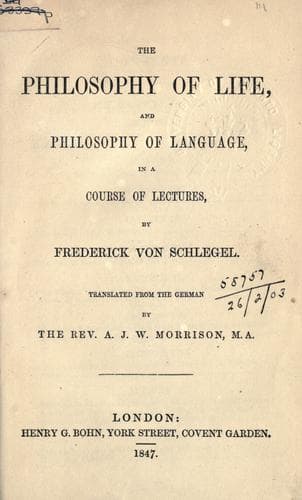
The philosophy of life, and philosophy of language, in a course of lecturesSchlegel, Friedrich von
Philosophy
The philosophy of life, and philosophy of language, in a course of lectures
Schlegel, Friedrich von
Language and languages -- Philosophy; Life; Philosophy
The universal deluge, of which the whole surface of our globe presents
so many and so great traces and proofs, forms a partition-wall, sternly
separating the earliest races of men from the subsequent generations. Of
the former it is only probable that they were very different from the
latter, not only in their manner of life, but also in their physical and
intellectual powers and endowments, and likewise, perhaps, in the nature
and mode of their moral corruption and depravity. My remarks, therefore,
may well be confined to this side of that great partition-wall. The next
great catastrophe, which is both expressly given out as a divine
retribution (and, as such, can be proved from profane history as much,
though not so universally, as the former), is the so-called Babylonian
confusion of tongues and the dispersion of nations. This, and that which
is so inseparably connected with it, the confusion of mythical ideas and
legends, is rather hinted at than fully and clearly detailed. The time,
too, is not given, though the locality is expressly mentioned. It is the
same one which, according to all other historical statements, was the
very spot of Western Central Asia, where that contagious malady of the
lust of conquest first arose, or, if we may be allowed the expression,
where this unhappy _invention_ was first made. This dispersion of
nations, however, was its natural punishment, since every unity which is
either politically false or intellectually untrue, must terminate in
chaotic dissolution. This historical fact is distinctly traceable in the
world of the ancients among the West Asiatic, South European, and North
African nations which dwell around the shores of the Mediterranean. Here
we can scarcely find our way out of the labyrinth of traces of
reciprocal relationship which abound, in their medley of cognate
languages and their chaos of legends, so remarkably agreeing, and yet
frequently so inconsistent in their ideas of nature, their far-reaching
theogonies, and the divine origination of their heroic families. These
chaotic contradictions, however, in which the poetry of heathendom
indulged without restraint, gradually undermined the old popular belief,
and led, consequently, at a later period, to a very favorable result.
Public-domain text, read in full here on John Shaqi.
Reviews
Reviews
No reviews yet
Be the first to share your thoughts on this work.
Elsewhere in the archive
Join the Discussion
Join the discussion
Sign in to leave a comment or review.
Sign InorCreate an account