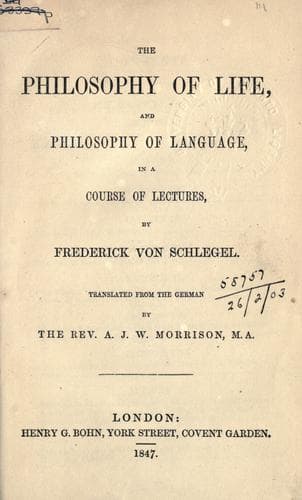
The philosophy of life, and philosophy of language, in a course of lecturesSchlegel, Friedrich von
Philosophy
The philosophy of life, and philosophy of language, in a course of lectures
Schlegel, Friedrich von
Language and languages -- Philosophy; Life; Philosophy
We recently remarked that the whole of that mixture of ideas, confusion
of legends and traditions, and that continual alternation between
anarchy and despotism, which in the olden times of heathendom ran
through its whole course of development, from the first dispersion of
nations to the establishment of the Roman empire over the world,
immediately applies to and is only to be understood of the West Asiatic
and South European races. In the East of Asia, two great nations or
empires, which together make up a third, if not the half, nearly, of the
population of the whole earth, have remained in a great measure free
from and uninfluenced by it. It would almost seem as if the Almighty,
with some special design, had kept and reserved them unto these last
times. For three if not four thousand years India has preserved
unchanged its institution of castes, and all its essential customs and
laws. The very fact that this ancient empire, so extensive, so abundant
in riches, and so singular in its nature, and with a civilized
population equal to that of the whole of Europe put together, should be
now conquered and held in subjection by the sea-ruling isles of Britain,
which the ancients named the Cassiterides, or Tin Islands, and described
as the ultimate limits of the habitable world, is one of the most
remarkable signs of our days. That in such great historical events, and
such singular juxtapositions, there rules some grand and mysterious
design of the Mind which regulates the course of human affairs, we can
not but feel; only we shall greatly err if we precipitately determine
its particular nature. The wiser and the safer course is to look forward
with attentive expectation to its further development. Already has this
remarkable approximation of the extreme East and West led to important
consequences. The enlargement of our historical information, by the
sources discovered in the East, has alone been so considerable as to
give greater coherence and consistency to our knowledge of the earlier,
and, indeed, of the very earliest times, and of the origin of mankind,
and to have afforded a growing testimony and a strong confirmation of
the truth of the sacred narrative.
The Celestial Empire too, with its monosyllabic language, remained until
very recently within its walls separate from and never mixing with the
rest of the world. Although China has been several times subjugated by
northern conquerors, it has, nevertheless, continued in all essential
respects the same. But now, in these modern times of universal ferment
and of change throughout the political world, China, too, has been set
in movement, and has become so far a conquering power, that she who in
the earlier centuries of Christianity was only known by name, through
fable, has become the immediate neighbor of two great European powers.
Public-domain text, read in full here on John Shaqi.
Reviews
Reviews
No reviews yet
Be the first to share your thoughts on this work.
Elsewhere in the archive
Join the Discussion
Join the discussion
Sign in to leave a comment or review.
Sign InorCreate an account