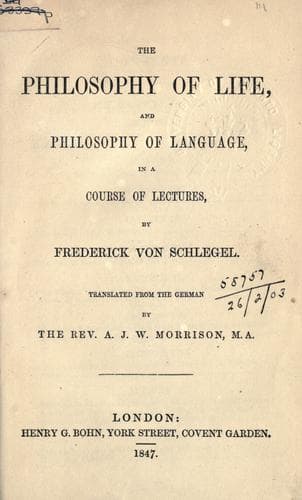
The philosophy of life, and philosophy of language, in a course of lecturesSchlegel, Friedrich von
Philosophy
The philosophy of life, and philosophy of language, in a course of lectures
Schlegel, Friedrich von
Language and languages -- Philosophy; Life; Philosophy
Dogmatic theology, or the science of positive belief, resembles pure
mathematics. Its ideas and formularies can not be too strictly, or too
simply, defined; nor, where it admits of demonstration, can its proofs
be carried out with too rigorous and mathematical a precision. For in
these matters it is impossible to give the least room or influence to
individual caprice without hazarding the loss of all that is most
essential in the positive articles of faith. Philosophy, on the other
hand, in treating of such subjects--or, at least, that part of it which
is occupied with these matters--resembles rather mixed geometry in its
several applications, such as practical mensuration, or the science of
fortification and the art of war. For philosophy is, if we may so speak,
an applied theology. Adopting the universal ideas of the one living God
and his overruling Providence, and, what is so closely connected
therewith, of the soul’s immortality and man’s free will, it adapts
them, in many valuable practical applications, to the whole and almost
boundless field of historical knowledge and the development of the human
race, as well as to all physical and experimental sciences, and even to
the wide domain of scientific disputes and merely human opinion, with
its several conflicting systems. In this course of practical application
philosophy needs not, in its expressions and formularies, scrupulously
to confine itself to the terminology of its sister science, or to repeat
its words with a careful exactness. On the contrary, its best and wisest
course is to move with freedom, changing and varying its expressions at
pleasure. For inasmuch as it is not itself so rigorously tied up as
theology is to authority, so it can not appeal to it with equal justice
in order to enforce assent to its own teaching. In the same way, too,
that in algebraic equations a mere hypothetical calculation is
oftentimes introduced, which, moreover, afterward suggests many a
valuable practical application, so, also, a similar hypothetical use of
the theological magnitudes or axioms, if we may so speak, is quite open
and allowable to philosophy in the pursuit of its merely scientific
ends. It is only the most general articles of the faith that philosophy
makes use of. At least, the minuter and sharply-defined determinations
of a positive creed are not immediately and indispensably necessary for
its object. Now, an overruling Providence, the soul’s immortality, and
the freedom of the will, are articles of universal belief, which,
although, perhaps, not couched in express words and definite notions,
yet still as germs and vague feelings exist, however deeply they may
slumber, in every human breast that is as yet pure and uncontaminated by
that captious skepticism which frets and corrodes itself with its
seeming perplexities. These, philosophy may safely take for granted.
Nay, it is its duty so to do; and where it does so in the right way,
Public-domain text, read in full here on John Shaqi.
Reviews
Reviews
No reviews yet
Be the first to share your thoughts on this work.
Elsewhere in the archive
Join the Discussion
Join the discussion
Sign in to leave a comment or review.
Sign InorCreate an account