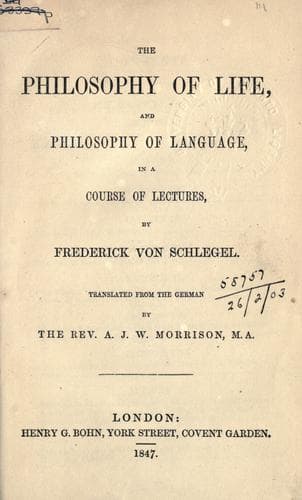
The philosophy of life, and philosophy of language, in a course of lecturesSchlegel, Friedrich von
Philosophy
The philosophy of life, and philosophy of language, in a course of lectures
Schlegel, Friedrich von
Language and languages -- Philosophy; Life; Philosophy
From amid these two dark clouds, which, if they shone at all, glimmered
only with the deceptive halo of the false light and hue of party, broke
the new dawn and sun of Truth--at first unobserved, nor understood by
any, so thickly had these mists overspread the horizon. But this new
genesis, and this full illumination, was no longer destined exclusively
for a single people. Accordingly, it gradually spread over the ten or
twelve great nations who occupy two parts of the habitable globe, and
also possess and govern the greatest portion of the third and the most
ancient. And it is, in short, by means of that intellectual superiority
and civilization which they owe to this springing of a new era, and this
first light, that the former bear rule in the remotest regions of the
earth.
Since the dawning of that day-spring eighteen centuries have elapsed,
and sadly torn and distracted is the present aspect of Christianity. We
should, no doubt, give a very distorted picture of the state of
Christendom were we anxiously to trace its resemblance, through every
minuter trait and nicer shade, to the old world at its close and at the
end of those fifteen centuries of Jewish preparation. Such a minute
parallel would be false, whether we were to compare it to the moral
state and character of that nation, mentally blinded and hurrying with
hasty steps toward its ruin, or even to the old heathen world of Rome,
already condemned by anarchy and infidelity. Still it is generally true.
For it is undeniable that man is perpetually relapsing into dissension
and party quarrels, even while the hand which sways the destinies of the
world, in ever-recurring epochs of renovation, is continually presenting
to him anew both truth and life, health and peace. And every one can
answer for himself the question whether this new proclamation of light
and truth, this divine message of peace and salvation, has yet reached
its full accomplishment. Has the Sun of Righteousness yet penetrated,
and cast its bright beams on all the relations of life, to the very
inmost joints of soul and spirit? Can it with perfect truth be said,
relatively to the whole human race, “And there is light”--that light, at
least, which alone is good, even because it shall remain forever? For
those meteoric sparks which flash across the universal night and
darkness, from the systems of man’s wisdom, which, crossing and
recrossing each other’s path, are soon again extinguished forever; or
those clouds of public opinion, charged with electric fluid and with
pestilence, which, for the most part, is but the public outburst of some
party passion; these emit no lasting, no salutary, and, therefore, no
true light. Dark and gloomy, too, perhaps, in its future prospects,
appears the long struggle between divine truth and human discord,
between light and darkness, between faith and infidelity. But the more
difficult and intricate the problem is which forms the theme of our
Public-domain text, read in full here on John Shaqi.
Reviews
Reviews
No reviews yet
Be the first to share your thoughts on this work.
Elsewhere in the archive
Join the Discussion
Join the discussion
Sign in to leave a comment or review.
Sign InorCreate an account